Fibromyalgia and the Fight-or-Flight Response
Jun 01, 2026
Understanding Fibromyalgia
You wake up already braced. The pain is there before the day begins. A stressful week makes it worse. A calm week does not always make it better. Your labs come back normal, which only deepens the confusion.
Short answer: In fibromyalgia, the fight-or-flight response, your body's threat system, tends to stay switched on. A body running in chronic threat amplifies pain signals, frays sleep, and stays guarded. The pain is real and the scans are clean because the problem is in how the nervous system processes signals, not in damaged tissue.
There is a reason for this pattern. It involves a system built to protect you: the fight-or-flight response.
The search for damage keeps coming up empty
Most fibromyalgia care looks for something broken. Scans, bloodwork, a structural cause. When the tests come back clean, you are often sent home without an answer. But no visible damage does not mean no cause. Modern pain science points somewhere else: the nervous system itself.
Fight-or-flight, stuck on
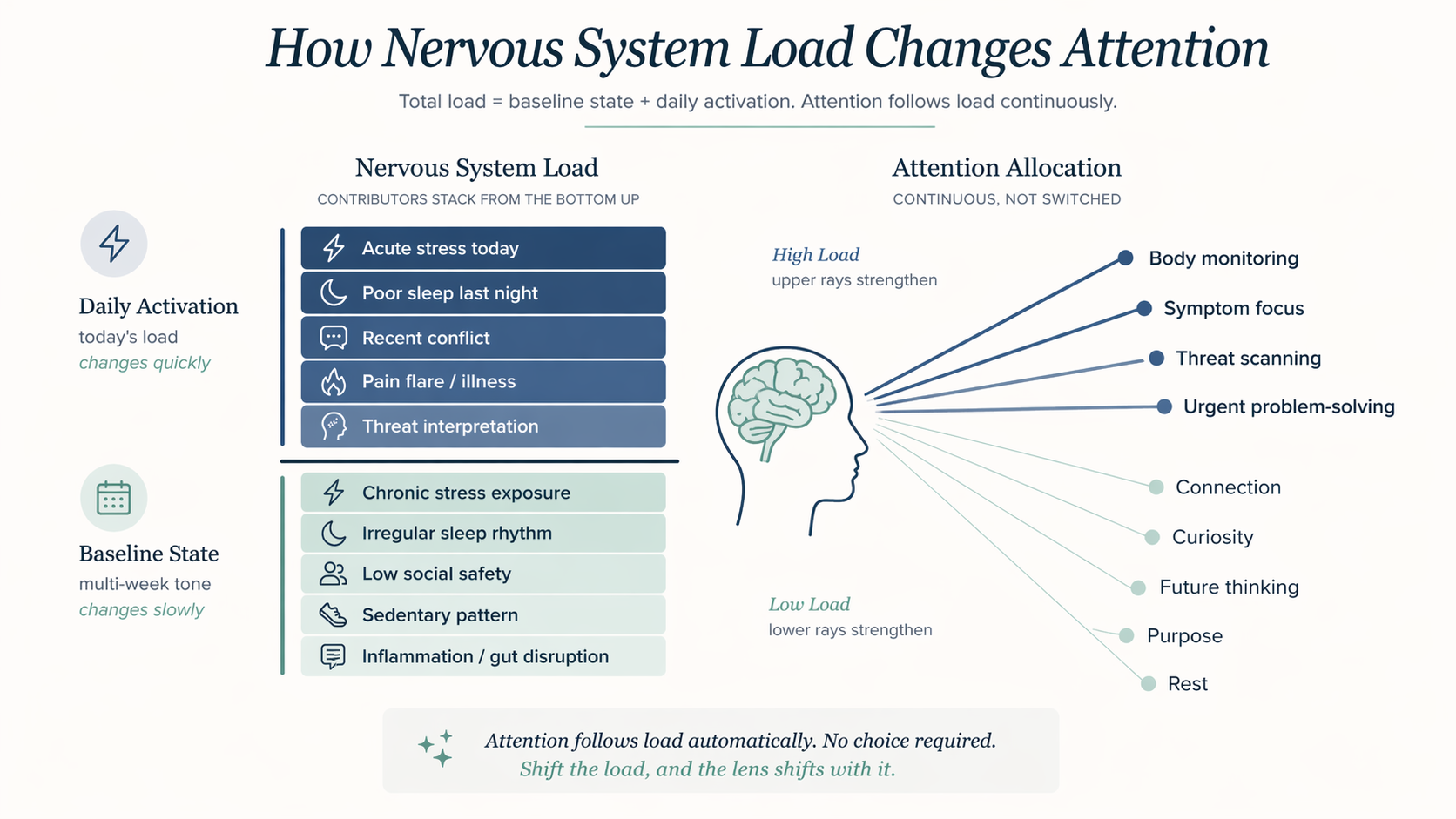
Fight-or-flight is your sympathetic nervous system. It evolved for short bursts of danger. Heart rate up, muscles tense, senses sharp, attention locked on threat. That state is useful for minutes. It is costly over months.
In fibromyalgia, this system tends to stay switched on. Researchers have described persistent, exaggerated sympathetic activity in people with fibromyalgia, paired with a blunted response to new stressors. A body running in chronic threat behaves differently. Sleep frays. Digestion stalls. Muscles stay guarded. Pain climbs. The system is not malfunctioning randomly. It is doing what a threat response does, just for far too long.
Why the volume gets turned up
When the nervous system stays activated, the brain and spinal cord amplify incoming signals. This is called central sensitization, and it is the best-supported model of fibromyalgia. The pain is real. It is also amplified. An ordinary touch can register as pain because the system is set to maximum gain.
Signs your system may be stuck in threat
This pattern shows up in more than pain. People often recognize several of these at once:
- Waking unrefreshed no matter how long you sleep.
- Feeling wired and exhausted at the same time.
- Heightened sensitivity to light, sound, touch, or smell.
- A gut that reacts to everything.
- Anxiety or a constant low hum of being on alert.
- Symptoms that spike with stress and ease in genuinely safe settings.
If that list feels familiar, it points away from "your body is broken" and toward "your nervous system is protecting you too hard."
Your body is not broken. Your nervous system is being protective.
The part that changes everything
This pattern is learned and dynamic, not fixed damage. That means it can be unlearned. In a randomized trial of a method that retrains how the brain interprets pain, two thirds of chronic pain patients were pain-free or nearly pain-free afterward, compared with one in five on placebo. The gains largely held a year later. Different condition than fibromyalgia, same underlying mechanism: neuroplastic pain maintained by a sensitized nervous system.
The work is to teach the system, slowly and credibly, that it is safe. That is the heart of the Loaded and Locked model and of nervous system retraining.
One thing to try today
Downshift the system on purpose. For two minutes, breathe so your exhale is longer than your inhale. A four-count in, a six or eight-count out. A long exhale is one of the few direct levers you have on the sympathetic nervous system. It will not erase pain. It begins to signal safety, and done daily it lowers the baseline the symptoms are built on.
Common questions
Is fibromyalgia a nervous system disorder?
That is the best-supported view. Fibromyalgia is driven by central sensitization and a sympathetic nervous system stuck in threat, rather than by damage to muscles or joints.
Can the fight-or-flight response cause chronic pain?
Yes. A threat response held on for months keeps the pain system at high gain, which amplifies ordinary signals into chronic pain even without tissue injury.
How do I get out of fight-or-flight mode?
Not by forcing it off. You lower the load and repeatedly signal safety: longer exhales, steady sleep, paced movement, less symptom-monitoring, and felt safety. Over time the system resets its default.
Is fibromyalgia an overactive nervous system?
In effect, yes. The nervous system is over-protective and over-amplifying. The aim of recovery is not to weaken it but to teach it that it no longer needs to run on high alert.
Why won't my nervous system calm down on its own?
Because the pattern is self-reinforcing. Pain raises threat, threat raises pain, and monitoring keeps both active. Breaking that loop usually takes deliberate, repeated practice rather than waiting.

Not another protocol. A map.
The free Fibromyalgia Healing Roadmap lays out the four phases for calming a sensitized nervous system and reducing symptoms.
Get the free roadmapReferences
- Ashar YK, Gordon A, Schubiner H, et al. Effect of Pain Reprocessing Therapy vs Placebo and Usual Care for Patients With Chronic Back Pain: A Randomized Clinical Trial. JAMA Psychiatry. 2022;79(1):13-23.
- Clauw DJ. Fibromyalgia: A Clinical Review. JAMA. 2014;311(15):1547-1555.
- Martinez-Lavin M. Fibromyalgia: When Distress Becomes (Un)sympathetic Pain. Pain Research and Treatment. 2012.
This article is educational and is not medical advice.