Can Central Sensitization Be Reversed?
Jul 02, 2026
Understanding Fibromyalgia
You finally have a name for what is happening in your body. Central sensitization. The relief of a real explanation lasts about a day, then a harder question shows up. If this is a setting your nervous system learned, can it be turned back down? Or is this just how your body works now?
Short answer: Central sensitization can change. It is a learned amplification maintained by the nervous system, not fixed structural damage, and the same plasticity that raised the volume can lower it. The research on reversal is genuinely mixed, and prevention is easier than cure. But most people who do consistent nervous-system work see the amplification come down over months, even without a guaranteed full reset.
Why this question matters so much
Once you understand central sensitization as the mechanism behind fibromyalgia, the ground shifts. If your pain is not damage, it is not permanent in the way a torn ligament is permanent. That is genuinely good news. It is also easy to overcorrect into a different kind of pressure: the belief that if you just find the right technique, you can switch it off completely.
Neither extreme is accurate. Central sensitization is not a life sentence. It is also not a light switch. Somewhere between "nothing can change" and "this is fully reversible in six weeks" is where the actual evidence sits, and that is where a realistic recovery plan gets built.
What "reversed" would actually mean
Reversed suggests a return to some earlier factory setting, a full erase. That is not how a learned nervous-system pattern works, and it is not the most useful goal to aim for. A more accurate word is retrained. The nervous system built a habit of amplifying ordinary signals into pain. That habit can weaken substantially with the right repeated input. Whether it disappears completely, and how long that takes, varies by person.
This distinction matters because it changes what you are watching for. You are not waiting for a single moment when sensitization switches off. You are watching the amplification gradually turn down: fewer flares, a higher threshold before pain spikes, faster recovery after a hard day.
What the research actually says
The honest picture is mixed, and it is worth sitting with the mixed version rather than a tidier one. Laboratory research shows that the synaptic changes underlying central sensitization can be reversible once the nervous system stops receiving the input that triggered them. Reactivating and updating sensitized pain pathways has been shown, in controlled studies, to reduce mechanical sensitivity.
At the same time, established sensitization is harder to unwind than it is to prevent. Interventions that block sensitization before it develops work better than those trying to undo it once it has been running for months or years. Some of the changes involved are described as deeply embedded in how genes are expressed in pain pathways, which is part of why sensitization that has been present for a long time tends to take sustained effort to shift, not a quick fix.
None of this is a reason for pessimism. It is a reason to expect a process, not an event.
Reversed is the wrong word for what happens. Retrained is closer.
Why plasticity is still the reason for hope
The same mechanism that makes long-standing sensitization stubborn is the mechanism that eventually loosens it: neuroplasticity. A randomized trial in people with chronic back pain found that a treatment built on teaching the brain that pain signals were safe, rather than dangerous, produced large and lasting drops in pain compared with usual care (Ashar et al., 2022). The pain pathways involved in that trial run on the same amplification machinery at work in fibromyalgia.
That result does not promise the same outcome for everyone. It does establish something important: a sensitized system can be taught new information, and that information can produce measurable, lasting change. The direction of travel is real, even when the endpoint is not full erasure.
What actually lowers the amplification
Sensitization comes down through repeated, boring, consistent inputs, not through one big intervention. A few of the levers that matter most:
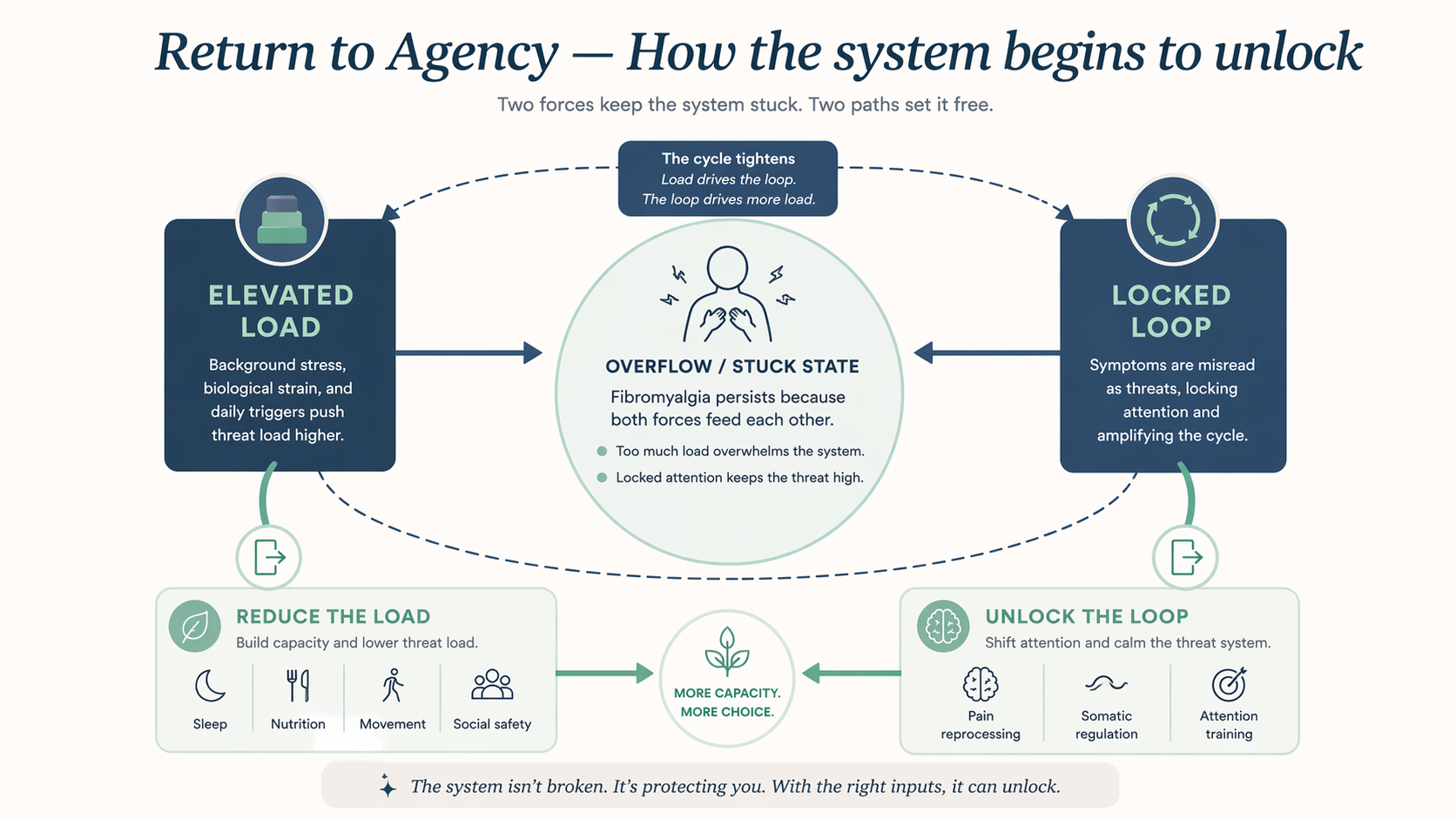
- Lowering background load. Sleep, a longer exhale, and fewer chronic stressors reduce the threat signal the system is amplifying in the first place. This is the loaded half of the Loaded and Locked model.
- Meeting sensation without alarm. Fear and bracing in response to pain confirm danger to a threat-detecting system and keep the gain high. Learning to notice a flare as a false alarm rather than proof of harm is the skill trained in pain reprocessing therapy.
- Reducing monitoring. Constant checking keeps attention locked on the body, and attention is one of the inputs the system uses to judge how dangerous a signal is. Less monitoring, over time, means a quieter system.
- Repetition over intensity. A sensitized baseline built up over months or years comes down the same way: steadily, not in one dramatic week.
This is the same core process described in nervous system retraining for fibromyalgia. None of it requires ignoring real pain or pretending symptoms are not there. It requires giving a protective system enough consistent evidence that the threat has passed.
What progress actually looks like
Progress rarely looks like a clean downward line. Expect fewer flares before you expect zero flares. Expect a shorter recovery time after a hard day before you expect no hard days. Expect a wider window of tolerance before you expect the pain threshold to disappear entirely. People often notice early shifts within a few weeks, with more durable change building over several months, similar to the pattern described for fibromyalgia remission more broadly.
Setbacks inside that process are not proof the work has failed. A sensitized nervous system is still learning, and learning is not linear.
Be wary of anyone promising a full, guaranteed reversal
Because the underlying science is genuinely hopeful, it attracts overclaiming. Anyone promising to permanently and completely reverse central sensitization in a fixed number of sessions, with no variation by person, is overselling a process that the research itself describes as gradual and individual. The honest claim is that sensitization is a changeable, learned state, that meaningful and often major improvement is realistic with consistent work, and that a full guarantee is not something anyone can ethically make.
Common questions
Can central sensitization actually be reversed?
It can change substantially. The amplification is a learned, plastic pattern rather than fixed tissue damage, and research shows the underlying pathways can be dialed back down. Full, guaranteed reversal is not something the evidence supports for everyone, but significant, lasting reduction is a realistic goal.
How long does it take to lower central sensitization?
There is no fixed timeline. Many people notice early shifts within a few weeks of consistent nervous-system work, while more durable change tends to build over several months. Longstanding sensitization generally takes longer to unwind than it took to prevent in the first place.
Is central sensitization permanent?
Not inherently. It is maintained by an ongoing pattern of amplification, and patterns that are maintained can also be retrained. It can persist indefinitely if the underlying threat load and symptom-monitoring loop are never addressed, but that is different from being biologically fixed.
What evidence shows central sensitization can improve?
Laboratory research shows the synaptic changes behind central sensitization can loosen once the nervous system stops receiving the input that triggered them. Clinically, a randomized trial of a treatment that retrained how the brain interpreted pain signals produced large, lasting pain reductions in chronic pain patients, pointing to the same amplification machinery at work in fibromyalgia.
Can central sensitization come back after it improves?
It can, particularly under a new period of high stress, poor sleep, or unresolved threat. This is not a sign that earlier progress was fake. A calmer baseline is generally easier to return to a second time than the first sensitized state was to unwind.

Not another protocol. A map.
The free Fibromyalgia Healing Roadmap lays out the four phases for calming a sensitized nervous system.
Get the free roadmapIf you want a structured, guided path rather than working this out alone, you can apply for the program.
References
Clauw DJ. Fibromyalgia: A Clinical Review. JAMA. 2014;311(15):1547-1555. jamanetwork.com
Ashar YK, et al. Effect of Pain Reprocessing Therapy vs Placebo and Usual Care for Patients With Chronic Back Pain. JAMA Psychiatry. 2022;79(1):13-23. jamanetwork.com
This article is for educational purposes only. It does not constitute medical advice, diagnosis, or treatment. Westlake Wellness coaching works alongside, not instead of, medical care. Always consult a qualified healthcare provider before making changes to your treatment plan.