Central Sensitization in Fibromyalgia, in Plain English
Jun 22, 2026
Understanding Fibromyalgia
A word gets used a lot around fibromyalgia, often without explanation. Central sensitization. It sounds clinical and vague. It is actually the clearest account we have of why your whole body hurts when nothing is torn or broken.
Short answer: Central sensitization is when the nervous system turns up the volume on pain. The brain and spinal cord amplify ordinary signals, so light touch, mild pressure, and small effort register as pain. In fibromyalgia this happens body-wide. It is real, it is physical, and because it is a learned setting, it can change.
If you have fibromyalgia, central sensitization is the mechanism underneath your symptoms. Understanding it changes what recovery looks like. You stop chasing damage that scans cannot find. You start working on the system that is actually generating the pain.
What central sensitization actually means
Your nervous system has a volume control for pain. Signals travel from the body to the spinal cord to the brain, and at each stage the system decides how much to amplify them. In a calm system, most ordinary input gets filtered out. You do not feel your clothes on your skin or the chair under you.
Central sensitization is what happens when that volume control gets stuck high. The spinal cord and brain become hyper-reactive. They amplify signals that should be filtered. The threshold for pain drops. Input that used to be neutral now reads as a threat. This is well documented as a core mechanism of fibromyalgia (Clauw, 2014).
The key word is central. The problem is not in your muscles or joints. It is in the central nervous system that processes the signals. That is why the pain is widespread, moves around, and travels with fatigue, poor sleep, and brain fog. One amplifier, turned up, affects the whole system.
Allodynia and hyperalgesia: the everyday signs
Central sensitization shows up in two specific ways, and you have probably lived both.
Allodynia is pain from things that should not hurt. A bra strap. A hug. A bedsheet against your legs. The light touch is real and the pain is real. The signal is simply being amplified far beyond what the touch warrants.
Hyperalgesia is when something mildly painful becomes severe. A small bump sends you through the roof. A normal day of activity costs you three days of recovery. The input is ordinary. The output is amplified.
Neither of these is exaggeration or oversensitivity as a character trait. They are the predictable result of a nervous system running at high gain. Naming them helps, because it locates the problem in signal processing rather than in your willpower or your imagination.
Why the system turned the volume up
A nervous system does not become sensitized for no reason. It does it to protect you. Under sustained threat, through stress, fear, illness, injury, or a long stretch of feeling unwell, the system raises its baseline guard. It lowers the pain threshold so it can catch danger early. In the short term this is useful. In fibromyalgia it gets stuck on.
This is the loaded state in the Loaded and Locked model. A chronically high load biases the whole system toward threat detection. Attention narrows onto sensation. The amplifier stays cranked because the system believes it is still in danger. Central sensitization is the physical face of that loaded state.
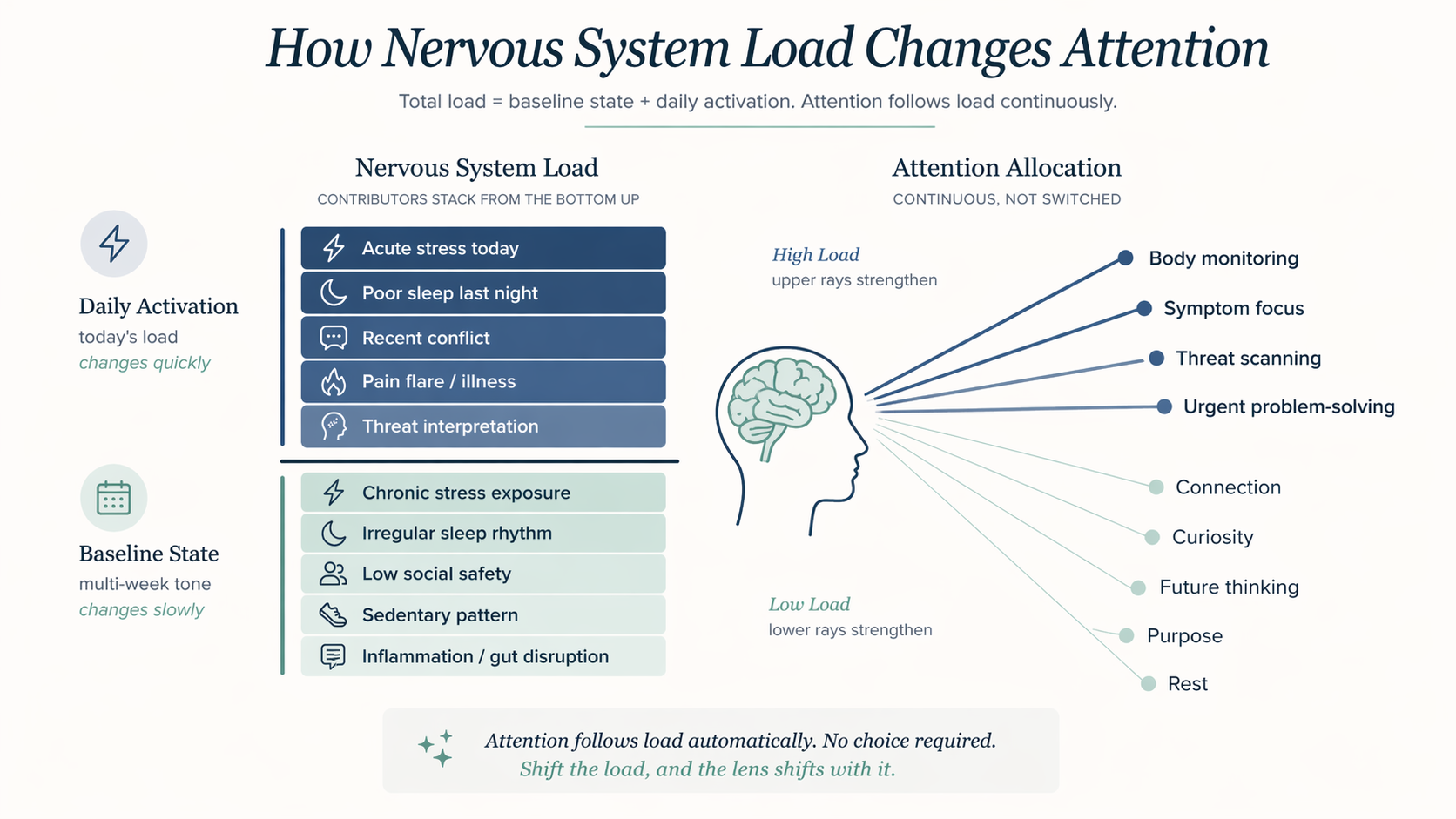
This is also the same machinery behind the fight-or-flight response that keeps muscles guarded and sleep broken. Sensitization and a stuck stress response are two descriptions of one overprotective system.
Why your scans and bloodwork look normal
This is the part that leaves people feeling dismissed. Severe pain, and every test comes back clean. The reason is simple once you see it. Imaging and labs look at tissue. Central sensitization is not in the tissue. It is in how the nervous system processes signals. Standard tests are not built to measure signal gain, so they look normal even when the pain is severe and real.
Normal scans are not proof that nothing is wrong. They are evidence that the problem is in the processing, not the parts. That reframe matters, because it points you toward work that can actually help. This is the same mechanism behind neuroplastic pain in fibromyalgia: real pain, generated by a sensitized system, not by damage.
Central sensitization is not damage. It is a setting. Settings can be changed.
Why this is a hopeful diagnosis
If your pain came from permanent structural damage, your options would be limited to managing it. Central sensitization is different. The same plasticity that turned the volume up can turn it back down. The system learned to amplify. It can learn to filter again.
This is not a promise of a quick fix or a guaranteed cure. It is a different and more workable problem. The goal is not to repair a broken body. It is to teach a sensitized system that it is safe, repeatedly, until the amplification settles. That work is the core of nervous system retraining for fibromyalgia.
What actually calms a sensitized system
You do not lower sensitization by attacking each symptom. You lower it by reducing the threat the system is responding to and by changing how you meet the signals it sends. A few starting levers:
- Lower the background load. Steady sleep, a longer exhale, gentle paced movement, and fewer chronic stressors all tell the system there is no emergency. Lower load raises the pain threshold over time.
- Meet sensation without alarm. When pain rises, the instinct is fear and bracing. That confirms danger and keeps the gain high. Learning to notice a sensation as a false alarm, not as proof of harm, is the skill that turns the volume down. This is the core of pain reprocessing work.
- Reduce monitoring. Constant symptom-checking directs attention onto the body, and attention is one input the system uses to decide how dangerous a signal is. Watching closely keeps it loud.
- Be consistent. A sensitized baseline took months to build. It comes down through repetition, not through a single good week.
None of this means ignoring your body or pushing through pain. It means giving a protective system steady evidence that the threat has passed, so it can stop amplifying.
Keep a doctor in the picture
Central sensitization explains a great deal about fibromyalgia, but it is not a reason to skip medical care. A physician should confirm the diagnosis and rule out other conditions that can mimic it. Coaching and nervous-system work run alongside that care, not instead of it. A coach does not diagnose, prescribe, or cure. The aim is to treat sensitization as the changeable setting it is, while keeping a clear medical picture.
Common questions
What is central sensitization in simple terms?
It is the nervous system turning up the volume on pain. The brain and spinal cord amplify ordinary signals, so the threshold for pain drops and input that should feel neutral registers as painful. In fibromyalgia this amplification happens across the whole body.
Is central sensitization the same as fibromyalgia?
They are closely linked but not identical. Central sensitization is the mechanism, the amplified signal processing. Fibromyalgia is the diagnostic label for a widespread pain condition driven largely by that mechanism. You can have central sensitization in other chronic pain conditions too.
What are the symptoms of central sensitization?
Widespread pain, pain from light touch (allodynia), an outsized response to minor pain (hyperalgesia), and heightened sensitivity to sound, light, smell, and temperature. It commonly travels with fatigue, unrefreshing sleep, and brain fog, because one amplified system affects the whole body.
Can central sensitization be reversed?
It can change. The amplification is a learned setting maintained by a sensitized system, and the same plasticity that raised it can lower it. Approaches that teach the nervous system it is safe have produced lasting pain reduction in chronic pain trials. Results vary and are not guaranteed.
How do you calm central sensitization?
By lowering the load the system is responding to and changing how you meet its signals. That means protecting sleep, using a longer exhale, pacing movement, reducing symptom-monitoring, and learning to meet sensation without alarm. Done consistently over weeks and months, this lowers the amplification.

Not another protocol. A map.
The free Fibromyalgia Healing Roadmap lays out the four phases for calming a sensitized nervous system.
Get the free roadmapReferences
Clauw DJ. Fibromyalgia: A Clinical Review. JAMA. 2014;311(15):1547-1555. jamanetwork.com
Martinez-Lavin M. Fibromyalgia: When Distress Becomes (Un)sympathetic Pain. Pain Research and Treatment. 2012. ncbi.nlm.nih.gov
This article is for educational purposes only. It does not constitute medical advice, diagnosis, or treatment. Westlake Wellness coaching works alongside, not instead of, medical care. Always consult a qualified healthcare provider before making changes to your treatment plan.