Why Fibromyalgia Symptoms Keep Coming Back
Jun 15, 2026
Understanding Fibromyalgia
You try something new. The symptoms quiet for a few weeks. Then they return, often just as strong. If this is your pattern, you are not failing at recovery. You are running into a specific problem: the system that generates your symptoms has not changed.
Short answer: Fibromyalgia symptoms keep returning because the nervous system has learned to produce them. Temporary relief from a supplement, a treatment, or a rest period does not retrain that pattern. The brain keeps generating symptoms as long as it perceives the body to be under threat. Recovery requires changing the nervous system's threat calibration, not just managing individual symptoms as they appear.
Why fibromyalgia does not behave like a normal injury
A sprained ankle heals. The pain fades as the tissue repairs. Fibromyalgia does not work this way because its source is not tissue damage.
Research consistently shows that fibromyalgia is driven by changes in how the central nervous system processes signals. The brain and spinal cord amplify inputs, generating widespread pain, fatigue, and cognitive difficulty even in the absence of ongoing structural injury. Researchers call this central sensitization. The nervous system becomes hypersensitive. Signals that would ordinarily be filtered or ignored are treated as threats.
What this means practically: when you treat the tissue, you treat the output. You do not reset the system producing it. Massage loosens tight muscles. Anti-inflammatories reduce peripheral inflammation. Rest quiets overexertion. Each addresses a symptom. None changes the underlying calibration of the nervous system responsible for generating it.
That is why treatments that work initially tend to stop working. The sensitized system reasserts itself. For a wider view of this mechanism, see the nervous-system approach to fibromyalgia recovery.
The nervous system learned to keep symptoms active
The brain generates pain and fatigue to protect you. It is doing its job. The problem in fibromyalgia is that the protective system has been calibrated by a long history of chronic load and unresolved threat.
Nervous systems are plastic. They reinforce patterns that appear important and repeated. When pain and threat signals persist long enough, the brain begins to anticipate them. It generates symptoms preemptively, as a forward-looking protective output, before a new trigger even arrives.
This is the core mechanism behind neuroplastic pain in fibromyalgia. The brain is not broken. It is applying what it learned. A pattern that was once a response to genuine threat has become the default output, running even when no new threat is present.
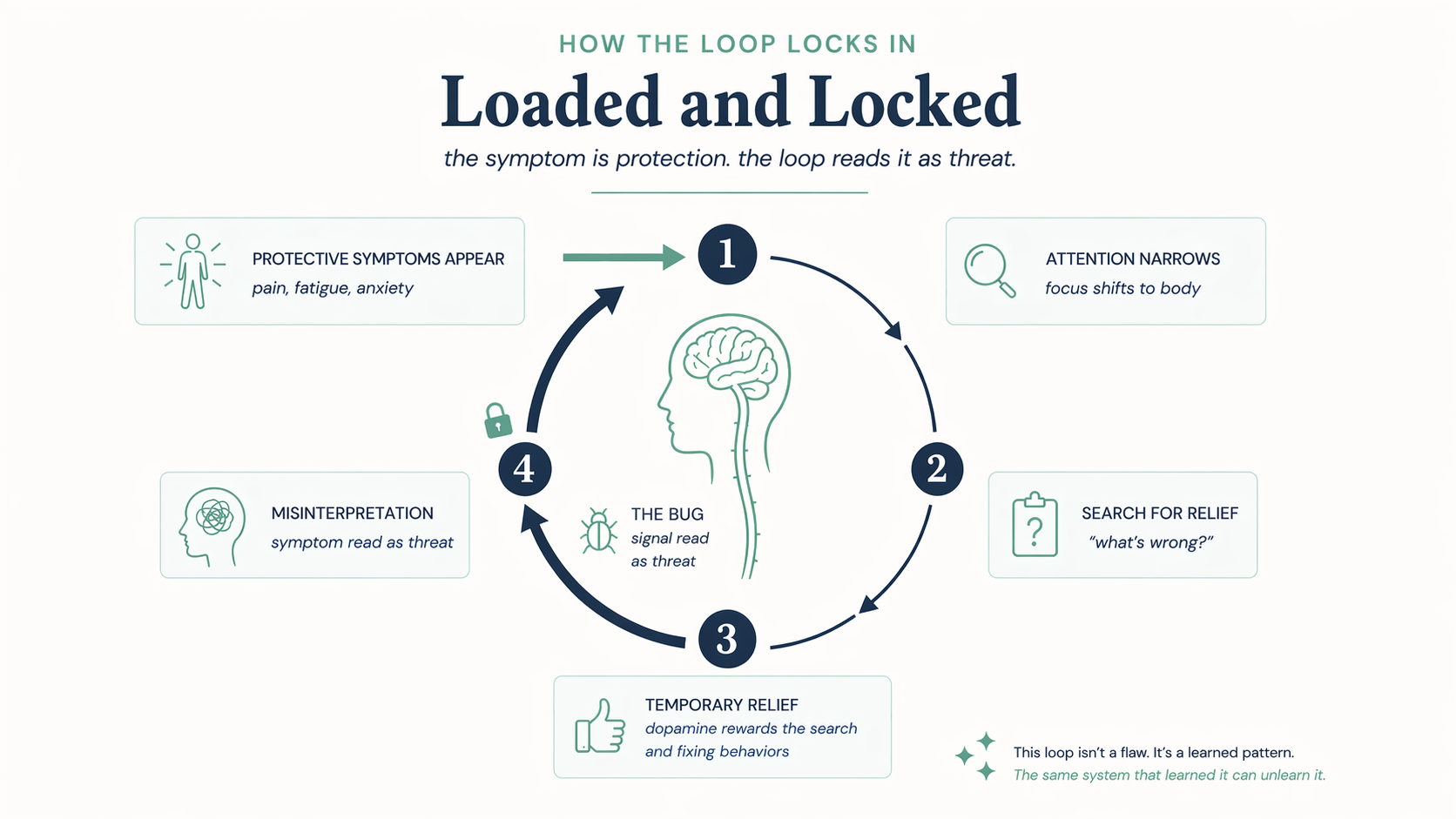
The Loaded and Locked model describes what sustains this state: a chronically elevated baseline load biases the nervous system toward threat detection. The thought stream narrows. Attention locks onto pain and sensation. The brain interprets that attentional focus as confirmation that the threat is real and ongoing.
Why temporary relief does not hold
When a supplement quiets a symptom, or a vacation reduces pain for a week, the body is receiving a real signal: load has dropped. But the nervous system's internal calibration, its set point for how dangerous the environment is, has not shifted. When the supplement stops or the stress returns, the system reasserts itself quickly.
This is also why stress so reliably brings fibromyalgia symptoms back. Stress does not cause new structural damage. It raises the threat load that was already present and pushes a sensitized system back over its threshold. The symptoms that return after a stressful week are not a relapse. They are the underlying state reasserting itself.
Lasting change requires lowering the baseline threat calibration itself. Not just managing individual flares when they appear.
The nervous system does not forget what it learned. But it can be taught something new.
How symptom monitoring keeps the loop tight
There is a second mechanism that keeps symptoms cycling beyond the baseline threat state. It is what happens when pain triggers searching.
When a symptom appears, urgency follows. That urgency drives monitoring, online research, and body checking. For a moment, the act of searching feels like control. It briefly reduces the helplessness that comes with unexplained pain. That brief relief reinforces the behavior. The brain learns: when I feel pain, I search, and searching temporarily reduces distress. So the loop continues.
The article on the fibromyalgia pain-search loop describes this in detail. The key point here is that symptom monitoring also directs attention, and attention amplifies pain signals. The brain uses attentional focus as one input when assessing how dangerous a signal is. Watching symptoms closely signals that they matter. That signal increases their amplitude. The person who tracks symptoms most carefully is often, paradoxically, the one keeping them loudest.
What actually changes the pattern
Two things have to shift for symptoms to stop returning. The baseline threat load has to come down. And the brain's relationship to symptoms has to change.
Reducing the baseline means improving sleep, reducing chronic stressors, building nervous system regulation through consistent practice, and addressing biological contributors, including gut health and nutrition, that add to the overall load. These are not quick fixes. They are conditions that, when sustained, change the nervous system's internal set point over time.
Changing the relationship to symptoms means learning to observe pain without treating it as an emergency. When the nervous system learns that a pain signal does not require a fear response, it begins to turn the signal down. Not immediately. But measurably, over weeks and months. This is what pain reprocessing therapy and somatic approaches address directly.
A structured approach that works on both axes simultaneously produces changes that hold. For an overview of what that structure looks like, see the guide to nervous system retraining for fibromyalgia.
Common questions
Why do fibromyalgia symptoms come and go?
Fibromyalgia symptoms fluctuate because the nervous system's threat level fluctuates. When daily load drops and you rest or feel safe, symptoms quiet. When load rises through stress, poor sleep, or emotional difficulty, the sensitized system amplifies signals. The fluctuation reflects the state of the nervous system, not new physical damage occurring each time.
Can fibromyalgia symptoms go away completely?
Many people with fibromyalgia experience major reductions in symptoms, including extended periods with little to no pain. This is more likely when nervous system regulation improves steadily over time and the brain's relationship to pain signals changes. Full resolution is not guaranteed, but significant and lasting improvement is a realistic goal for people who engage in structured recovery work.
Why does stress bring fibromyalgia symptoms back?
Stress raises the threat load in a nervous system that is already sensitized. It does not cause new structural damage. It pushes the system back over the threshold where it generates symptoms. This is why stress is such a consistent trigger, and it is also why lowering the overall baseline threat calibration, not just managing individual stressors, is central to durable recovery.
Why do treatments seem to help at first and then stop working?
Most treatments address the output of a sensitized nervous system. They reduce one symptom, loosen one area of tension, or quiet one flare. They do not change the underlying calibration that produces symptoms. When the treatment ends or a new stressor arrives, the calibrated system reasserts itself. This is not a failure of the treatment or the person. It is a sign that the source has not been addressed.
Is there a way to stop fibromyalgia from cycling?
Yes, but it requires working on the nervous system's baseline state rather than managing individual symptoms reactively. That means consistent regulation practice, reducing chronic load, improving sleep and nutrition, and changing how the brain responds to pain signals. These are processes that, done consistently over months, produce results that hold rather than fading when one treatment ends.

Not another protocol. A map.
The free Fibromyalgia Healing Roadmap lays out the four phases for calming a sensitized nervous system.
Get the free roadmapReferences
Clauw DJ. Fibromyalgia: A Clinical Review. JAMA. 2014;311(15):1547-1555. jamanetwork.com
Ashar YK, et al. Effect of Pain Reprocessing Therapy vs Placebo and Usual Care for Patients With Chronic Back Pain. JAMA Psychiatry. 2022;79(1):13-23. jamanetwork.com
This article is for educational purposes only. It does not constitute medical advice, diagnosis, or treatment. Westlake Wellness coaching works alongside, not instead of, medical care. Always consult a qualified healthcare provider before making changes to your treatment plan.