Why Your Brain Predicts Pain Before It Happens
Jul 06, 2026
The Loaded and Locked Model
You feel a flare building before you have done anything to explain it. A hard conversation is coming, or a deadline, or just a day that feels like too much, and your body starts bracing hours before anything actually happens. That is not your imagination getting ahead of you. It is your brain doing exactly what it is built to do.
Short answer: Modern pain science treats the brain as a prediction machine, not a damage detector. It constantly generates a best guess about how much danger and pain to expect, based on past experience, then adjusts that guess as new signals arrive. In a sensitized nervous system, those predictions run high by default, so pain can build before an actual trigger arrives. Understanding this is not fatalistic. Predictions are learned, which means they can be updated.
The bracing that comes before the trigger
Most explanations of fibromyalgia pain start after the fact: something happened, then the pain followed. A huge amount of what people describe does not fit that order. The ache that shows up before a hard week starts. The exhaustion that arrives while still just anticipating a flare-worthy day. The tightening in your shoulders during a tense conversation that has not turned into anything yet.
Anticipation cannot injure tissue. But anticipation can change what the brain expects to feel, and expectation is one of the most powerful inputs to pain itself.
Pain was never just a damage signal
The old model of pain treats it like a fire alarm wired directly to tissue damage: injury triggers a signal, the signal travels to the brain, the brain registers pain in proportion to the damage. That model explains a stubbed toe well. It does not explain fibromyalgia, where pain is often severe and widespread while standard tissue tests come back normal.
The modern alternative, sometimes called the predictive coding or Bayesian brain model of pain, treats pain less like a fire alarm and more like a forecast. The brain constantly generates a prediction about what is happening in the body, using past experience, current context, and incoming sensory signals together. Pain is the output of that prediction, not a direct transcript of damage. A 2023 clinical review in Current Pain and Headache Reports describes pain perception as a hierarchical process where bottom-up sensory input collides with top-down expectation, and notes that chronic pain can reflect the brain settling on pain as its best explanation for ongoing bodily signals, even when tissue findings do not support that conclusion.
What this looks like inside a sensitized nervous system
This is not just a theory borrowed from psychology. A 2022 study in Frontiers in Human Neuroscience recorded brain activity in people with fibromyalgia while they anticipated a painful stimulus, and found an abnormal pattern of pain-expectation signaling compared with people without the condition, including altered anticipatory brain activity and a blunted ability of predictive cues to shape the brain's response once the stimulus arrived. In plain terms: the brain's forecasting system for pain behaves differently in fibromyalgia, and that difference shows up before the pain itself does.
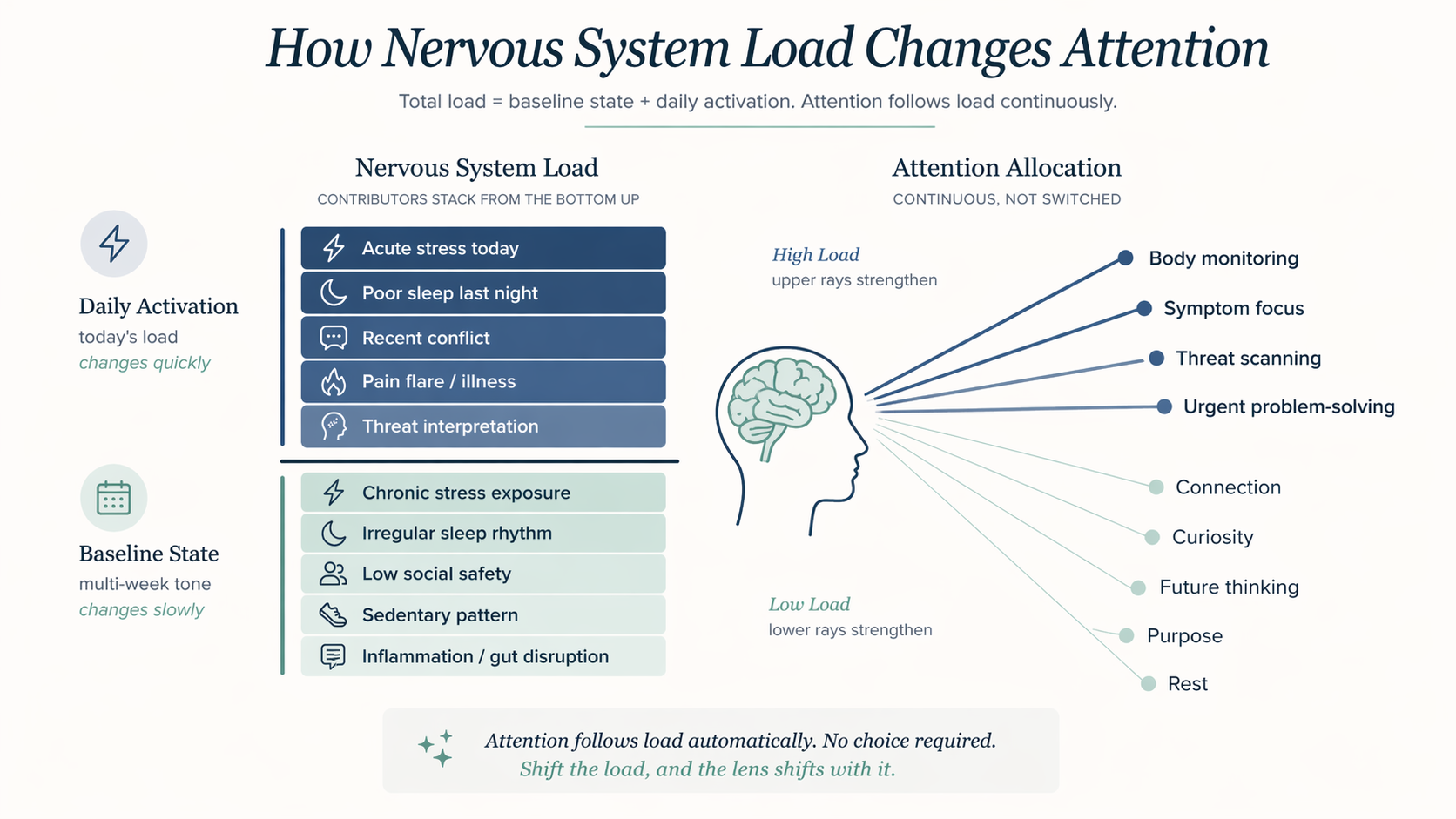
This lines up with central sensitization, the broader pattern where a nervous system has turned its volume knob up on threat and pain signals generally. A sensitized system does not just amplify pain after it arrives. It runs a higher, more trigger-happy prediction going into any situation that even resembles past danger, so the body can start bracing before the day has given it any real evidence to brace against.
Where this fits the anticipatory-avoidance picture
This is also the mechanism behind a working theory central to how we think about fibromyalgia: in a chronic threat state, the brain can use pain and other symptoms as an intensified, anticipatory form of anxiety, designed to drive avoidance and push you toward safety before anything goes wrong. Framed this way, symptoms that build ahead of a hard day are not a malfunction. They are the same anticipatory survival logic that makes any organism brace for a threat it expects, misapplied to modern stress that rarely carries real physical danger. This is a working explanatory model, not a settled diagnostic fact, but it is consistent with the electrophysiology above, and it gives language to something many people with fibromyalgia feel but rarely hear named: the sense that their body knows something is coming before they do.
Your brain is not overreacting to nothing. It is reacting to what it expects, before it has evidence either way.
Why this is hopeful instead of fatalistic
A prediction is not a permanent fact. It is a running estimate, built from experience, and estimates change when given new, consistent evidence. This is the real basis for pain reprocessing work, not a hopeful slogan attached to it after the fact. A randomized clinical trial published in JAMA Psychiatry found that a brief course of pain reprocessing therapy produced substantially greater pain reduction in people with chronic back pain than placebo or usual care, largely by helping the brain reappraise pain signals as safe rather than dangerous, exactly the kind of prediction update this model describes.
Predictions reinforced for years do not reverse in a day, and noticing this pattern alone will not resolve it. But the direction of travel matters. A system that generates pain by prediction can, with the right input, learn a different prediction. That is a fundamentally different starting point than a system with fixed structural damage.
Working with your predictions instead of fighting them
You cannot argue a prediction into changing by force of will, but you can change the evidence your nervous system is working from over time.
- Notice the bracing, name it as a prediction. "This is my brain predicting pain, not pain that has arrived." Naming it creates a small gap between the forecast and automatic belief in it.
- Separate anticipation from evidence. Ask what has actually happened in your body right now, versus what you expect to happen. They are not the same signal, even when they feel identical.
- Give the system disconfirming experience. Each time a feared day unfolds without the pain matching the prediction, that is real data your nervous system can use. Consistency over weeks matters more than any single instance.
- Lower the baseline load doing the predicting. A system carrying less chronic threat load has less reason to forecast danger by default. Same work described in nervous system retraining for fibromyalgia.
- Expect this to be gradual. Predictions built over years update on a similar timescale. How far sensitization can reverse is still being studied, but progress here tends to look like fewer, smaller bracing episodes over months, not one before-and-after moment.
What this does not mean
This model does not mean fibromyalgia pain is imagined, exaggerated, or under someone's direct control. A prediction generated by the nervous system produces pain that is completely real, the way a hallucination is a completely real visual experience even though nothing external caused it. The pain is not in question. What is more changeable than a purely structural, damage-based model suggests is the mechanism generating it.
Common questions
Can your brain really cause pain before anything happens?
Yes, in the sense that the brain generates pain as a prediction based on past experience and context, not only as a direct readout of tissue damage. Anticipating a stressful or symptom-triggering situation can shift that prediction upward before any new physical event has occurred, which is why bracing and pain can build ahead of a difficult day.
Is this the same thing as anxiety causing pain?
It overlaps but is not identical. Anxiety is one input that can raise the brain's pain prediction, but the mechanism described here, predictive coding, is a broader model of how the brain generates pain generally, using expectation alongside sensory signals. Anticipatory pain in fibromyalgia is better understood as intensified anticipatory signaling than as pain being "caused by" anxiety in a simple sense.
What is predictive coding, in plain terms?
It is a model of how the brain works generally, applied here to pain: the brain constantly forecasts what is about to happen in the body, using past experience and current context, then compares that forecast to incoming signals. Pain is the brain's best current guess about the meaning of a bodily signal, not a fixed transcript of damage, which is why the same signal can be felt very differently depending on what the brain expects.
Does this mean fibromyalgia pain is not real?
No. A prediction-driven pain signal is a completely real pain experience. The nervous system is doing real work to generate it. What changes under this model is not whether the pain is real, but how changeable its source turns out to be, since predictions can be updated in a way that fixed tissue damage cannot.
Can you retrain your brain's pain predictions?
There is real evidence for this. Pain reprocessing approaches that help the brain reappraise pain signals as safe rather than dangerous have shown meaningful pain reduction in clinical trials. Updating a prediction built over years takes consistent, repeated counter-evidence rather than a single insight, so progress tends to be gradual rather than immediate.
Not another protocol. A map.
The free Fibromyalgia Healing Roadmap lays out the four phases for calming a nervous system that has learned to predict pain too readily. If you want to work through it with a coach, you can also apply for the program.
Get the free roadmapReferences
Lersch FE, Frickmann FCS, Urman RD, Burgermeister G, Siercks K, Luedi MM, Straumann S. Analgesia for the Bayesian Brain: How Predictive Coding Offers Insights Into the Subjectivity of Pain. Current Pain and Headache Reports. 2023;27(11):631-638. link.springer.com
Barjola P, Peláez I, Ferrera D, González-Gutiérrez JL, Velasco L, Peñacoba-Puente C, López-López A, Fernandes-Magalhaes R, Mercado F. Electrophysiological indices of pain expectation abnormalities in fibromyalgia patients. Frontiers in Human Neuroscience. 2022. frontiersin.org
Ashar YK, Gordon A, Schubiner H, et al. Effect of Pain Reprocessing Therapy vs Placebo and Usual Care for Patients With Chronic Back Pain: A Randomized Clinical Trial. JAMA Psychiatry. 2022;79(1):13-23. jamanetwork.com
Clauw DJ. Fibromyalgia: A Clinical Review. JAMA. 2014;311(15):1547-1555. jamanetwork.com
This article is for educational purposes only. It does not constitute medical advice, diagnosis, or treatment. Westlake Wellness coaching works alongside, not instead of, medical care. Always consult a qualified healthcare provider before making changes to your treatment plan.