Fibromyalgia and Trauma: What the Research Actually Shows
Aug 10, 2026
Related Conditions
Somebody has probably already told you that fibromyalgia and trauma are connected. Maybe a practitioner said it gently. Maybe an article said it flatly, in a way that suggested you were hiding something from yourself. Either way it lands strangely, because it can be true and useless at the same time. Knowing that something happened to you twenty years ago does not tell you what to do on a Tuesday when your arms hurt.
Short answer: Trauma is one of the strongest known risk factors for fibromyalgia, and it is not a cause. Meta-analysis puts the odds of fibromyalgia meaningfully higher after abuse, medical trauma, and other major stressors, while also concluding that stressors are one of many contributors. Plenty of people with fibromyalgia have no trauma history at all. Where trauma does matter, current research suggests it acts on pain through anxiety and through how much you fight the sensation, both of which are workable now.
What the research actually found
The best single summary is a 2021 meta-analysis in Psychological Medicine. It pooled nineteen case-control studies and compared six different types of lifetime stressor against fibromyalgia status.
Every one of the six showed a significant association. The odds were highest for physical abuse, at roughly three times, and for total abuse exposure. Sexual abuse sat around two and a half times. Medical trauma, emotional abuse, and other lifetime stressors were lower but still real. Whether the exposure happened in childhood or adulthood did not substantially change the picture.
A 2025 systematic review in Psychiatry Research looked at the narrower question of post-traumatic stress disorder specifically, across twenty studies published between 1993 and 2023. It found a consistent association between fibromyalgia and PTSD, with some evidence that people carrying both have more severe fibromyalgia symptoms, and more limited evidence that PTSD raises the likelihood of developing fibromyalgia in the first place.
So the link is real and it has been measured repeatedly. That is the part most articles get right.
The part most articles get wrong
The authors of that meta-analysis ended on a sentence worth reading twice. Stressors, they wrote, are likely to be one of many risk factors, and fibromyalgia is best approached from a biopsychosocial perspective.
Read carefully, that is a limit, not an endorsement. A raised odds ratio across a population does not tell any individual person why they hurt. It certainly does not license anyone to inform you that you must have unresolved trauma because you have widespread pain.
Many people with fibromyalgia have no trauma history. They are not repressing one. If you have gone looking for a buried event and found nothing, the honest reading of the evidence is that there may be nothing to find, and your symptoms are no less real for it.
Trauma raises the odds. It does not write the verdict. And the absence of a story does not disqualify your pain.
Why a past threat can become present pain
Here is the mechanism, without mysticism.
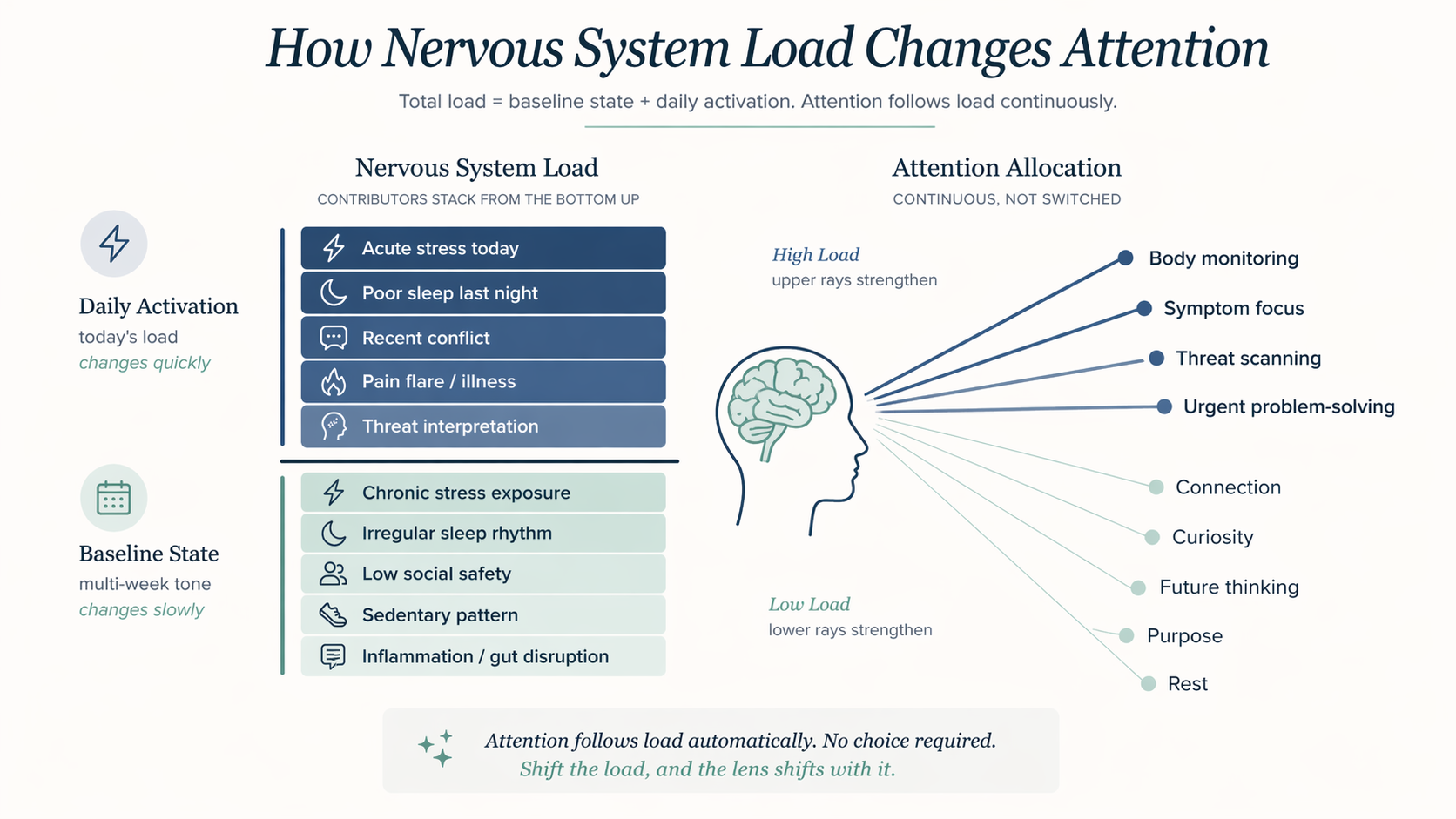
Your nervous system runs a continuous background estimate of how dangerous the world is. That estimate sets the gain on everything downstream: how loudly a signal from your shoulder gets reported, how fast your fight-or-flight response triggers, how much sleep it will allow you.
Serious threat, especially threat that was inescapable at the time, teaches that estimate to sit high. It is not a malfunction. A system that has learned the world can hurt you without warning is behaving sensibly by staying ready. The cost is that it never fully stands down, and a system that never stands down amplifies. That amplification is central sensitization, and it is the mechanism at the center of fibromyalgia.
In the Loaded and Locked model we call this load. Trauma is load. So is chronic stress, poor sleep, illness, isolation, and the slow grind of not being believed by clinicians. They all push the same dial. Trauma just pushes it harder and holds it there longer.
The 2025 finding that changes what you can do about it
This is the most useful piece of research on the subject, and almost nobody has written about it for a general audience.
A 2025 study in BMC Psychology assessed 82 women with fibromyalgia, 41 women with other central sensitization conditions, and 43 healthy controls. The fibromyalgia group reported more trauma, more severe trauma, and higher rates of PTSD than either comparison group. Within the fibromyalgia group, the women who also met criteria for PTSD had a worse clinical picture across the board.
Then the researchers asked the better question. Not whether trauma and sensitization travel together, but what runs between them.
They tested anxiety and pain acceptance as mediators. The total indirect path from post-traumatic stress symptoms to central sensitization, running through those two variables, was statistically significant, though each individual path fell just short on its own. The model accounted for about a fifth of the variance in sensitization.
That is a modest, honest result, and it points somewhere specific. The route from an old event to today's pain appears to run through how anxious the system currently is, and through how hard you are fighting the sensation. Neither of those lives in the past. Both are addressable this month.
What this does not mean you have to do
It does not mean you have to excavate anything.
There is a widespread assumption that if trauma is involved then the only door is to go back through the worst thing that happened to you and relive it in detail. That assumption keeps people out of care entirely, which is the worst possible outcome.
Lowering nervous system load does not require retelling. Sleep, daylight, gentle movement, connection, and reducing the daily volume of threat all lower the same dial, and none of them ask you to open anything you are not ready to open. Learning that a sensation is output from a sensitized system rather than evidence of damage lowers it further. That work is described in nervous system retraining for fibromyalgia.
Where trauma processing is genuinely indicated, that is therapist work. A coach does not do it and should not pretend otherwise. If you meet criteria for PTSD, the research above is a strong argument for getting proper trauma treatment from a licensed clinician alongside anything else you are doing, not instead of it.
Where to start this week
Pick load, not history.
Choose the single largest ongoing threat input in your current life. Not the biggest thing that ever happened. The loudest thing happening now. A conflict you keep rehearsing. Four hours of sleep. A calendar with no gaps. The forum you read at midnight.
Reduce that one input by a noticeable amount for two weeks and watch what your symptoms do. Most people find some movement. That movement is information, and it is the kind that is difficult to argue with: it tells you the system is still responsive, which is the whole premise of recovery.
Not another protocol. A map.
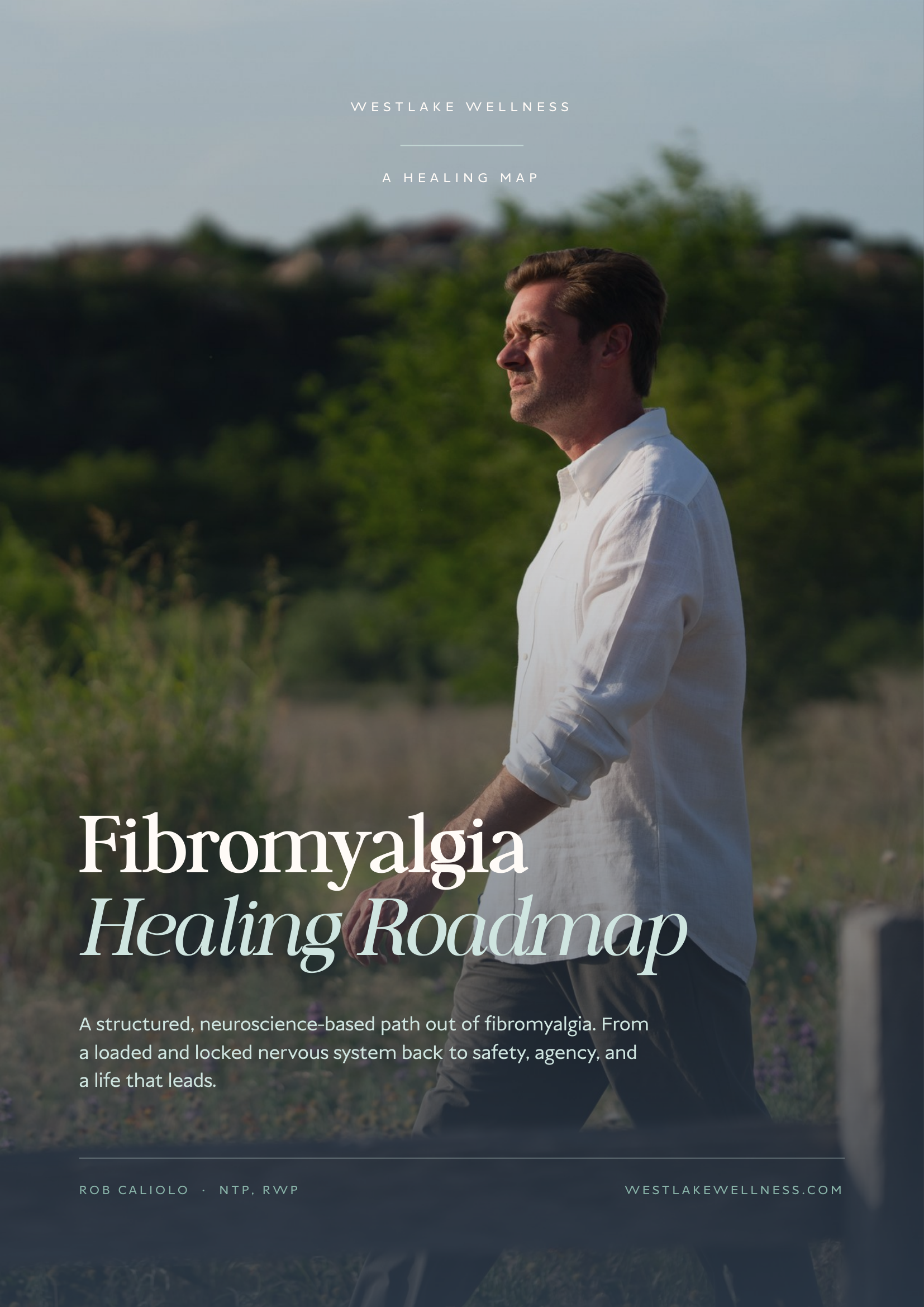
The free Fibromyalgia Healing Roadmap lays out the four phases for lowering load and calming a sensitized nervous system, in order.
Get the free roadmapCommon questions
Does trauma cause fibromyalgia?
No. Trauma is a risk factor, and a substantial one. A 2021 meta-analysis of nineteen case-control studies found significantly raised odds of fibromyalgia across six types of lifetime stressor, highest for physical abuse. The same authors concluded that stressors are likely one of many risk factors. Many people develop fibromyalgia with no trauma history at all.
Can you have fibromyalgia without any trauma?
Yes, and it is common. Infection, injury, surgery, prolonged stress, poor sleep, and genetic factors are all associated with onset. If you have looked for a hidden traumatic event and not found one, that is a legitimate result rather than a failure of insight. Your symptoms are not less real without a story attached.
How does old trauma turn into physical pain years later?
Through the threat setting your nervous system runs on. Serious threat teaches the system to keep its background danger estimate high, and a system on high alert amplifies incoming signals. That amplification is central sensitization, the mechanism at the center of fibromyalgia. The pain is produced by real biology responding to a learned state, not imagined.
Do I have to process my trauma to get better from fibromyalgia?
Not necessarily, and not as a first step. Lowering overall nervous system load through sleep, movement, connection, and changing what symptoms mean to you does not require revisiting anything. Where PTSD is present, evidence supports getting proper trauma treatment from a licensed therapist alongside other work. Trauma processing is clinical work and sits outside coaching scope.
What did the 2025 research find about how trauma affects fibromyalgia pain?
A 2025 study in BMC Psychology of 82 women with fibromyalgia found that anxiety and pain acceptance together carried a significant indirect path between post-traumatic stress symptoms and central sensitization severity, explaining roughly a fifth of the variance. The individual paths fell just short of significance. It suggests the route from past trauma to present pain runs partly through current anxiety and current resistance to sensation, both of which can be worked on now.
References
Kaleycheva N, Cullen AE, Evans R, Harris T, Nicholson T, Chalder T. The role of lifetime stressors in adult fibromyalgia: systematic review and meta-analysis of case-control studies. Psychological Medicine. 2021;51(2):177-193. cambridge.org
Aguirre de Carcer Vidal A, Rabito Alcon MF, Izquierdo Sotorrio E. Fibromyalgia and post-traumatic stress disorder: A systematic review. Psychiatry Research. 2025. sciencedirect.com
Martinez MP, et al. Trauma and psychological impact in fibromyalgia and other central sensitization syndromes: the role of anxiety and pain acceptance. BMC Psychology. 2025;13:1251. link.springer.com
Clauw DJ. Fibromyalgia: A Clinical Review. JAMA. 2014;311(15):1547-1555. jamanetwork.com
This article is for educational purposes only. It does not constitute medical advice, diagnosis, or treatment. Westlake Wellness coaching works alongside, not instead of, medical and mental health care, and does not provide trauma therapy. If you are struggling with the effects of trauma, please speak with a qualified licensed clinician.