
Break the Loop
SELF-PACED CHRONIC PAIN COURSE · $149
Why you suffer from chronic pain, and the practices that retrain your nervous system to stop it.
GET THE COURSEFull refund within fourteen days, for any reason.
Break the Loop
SELF-PACED CHRONIC PAIN COURSE · $149
Why you suffer from chronic pain, and the practices that retrain your nervous system to stop it.
GET THE COURSEFull refund within fourteen days, for any reason.
RELIEF THAT DOESN'T LAST
You've tried plenty. That was never the problem.
Physical therapy. Massage. A scan. Stretches you do every morning. Maybe medication that takes the edge off without explaining why the pain keeps coming back.
Some of it helped. Some of it didn't last.
Maybe the pain started with an injury. Maybe it appeared without an obvious reason. Either way, it keeps getting in the way of ordinary life, and you still don't have a satisfying explanation for why it persists or why some days hurt so much more than others.
Understand why the pain keeps coming back, and learn what you can do to change the pattern.
Before you consider surgery, another injection, or stronger pain medication, there's something important you should know.
The right next step depends on what's keeping the pain going.
The pain is real. Tissue damage isn't the only reason it can persist.
A nervous system can become loaded by injury, poor sleep, pressure and emotional strain. It can stay locked when the pain itself becomes another threat.
Load can come down. A learned pain loop can change. This course helps you recognize the pattern and practice a different response.
What this course is
Understand the loop. Practice the way out.
Break the Loop is a short, self-paced course built around the Loaded & Locked model: what adds threat to your system, how pain can become part of that threat, and how to begin changing both.
You'll explore your own symptom pattern, work on sleep, and try practices drawn from well-supported research for chronic pain.

PART ONE
Danger, not damage
- Why real pain can continue after an injury has healed, and what scans can and cannot tell you
- How the nervous system learns protection, and what gives us reason to expect change
- What needs medical attention, and why this explanation belongs alongside your assessment

PART TWO
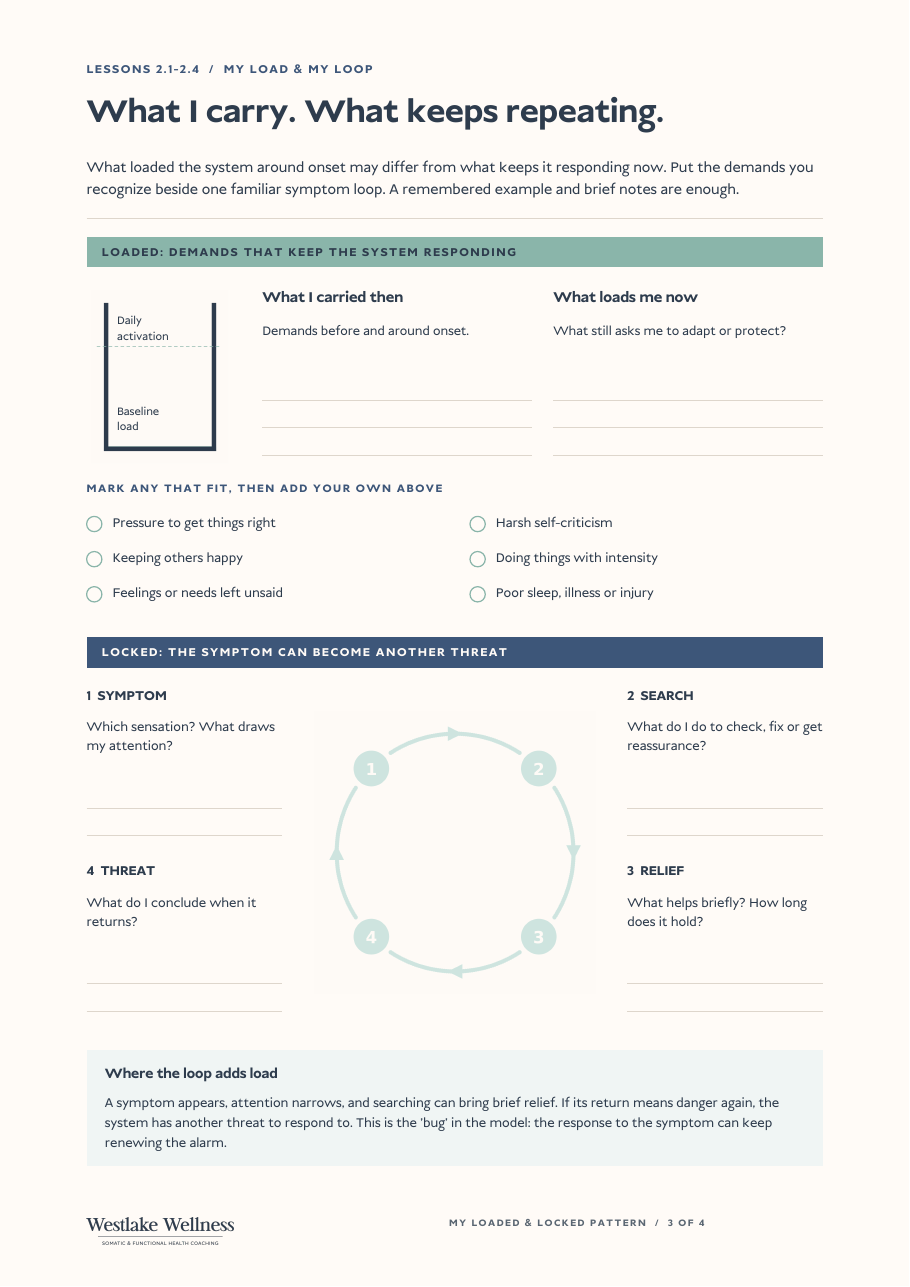
Your Loaded & Locked pattern
- What was happening when symptoms began, and what may have loaded your system then
- How pain, fear, checking and the search for relief can keep adding threat now
- Recognize the clues that your nervous system is contributing to the pain, and connect them to your own history

PART THREE
Sleep and a different response to pain
- Practical sleep changes, including what to do at three in the morning
- Pain Reprocessing Therapy: teach your nervous system a different response to familiar, assessed pain
- Guided somatic tracking: noticing with curiosity instead of treating every sensation as a problem to solve

PART FOUR
Emotional load and your next steps
- How perfectionism, self-criticism and constant pressure can add to the load
- A private writing practice to make room for feelings you usually edit out
- A simple two-week plan that brings sleep, emotional load and your response to pain together
PART ONE
Danger, not damage
- Why real pain can continue after an injury has healed, and what scans can and cannot tell you
- How the nervous system learns protection, and what gives us reason to expect change
- What needs medical attention, and why this explanation belongs alongside your assessment
PART TWO
Your Loaded & Locked pattern
- What was happening when symptoms began, and what may have loaded your system then
- How pain, fear, checking and the search for relief can keep adding threat now
- Recognize the clues that your nervous system is contributing to the pain, and connect them to your own history
PART THREE
Sleep and a different response to pain
- Practical sleep changes, including what to do at three in the morning
- Pain Reprocessing Therapy: teach your nervous system a different response to familiar, assessed pain
- Guided somatic tracking: noticing with curiosity instead of treating every sensation as a problem to solve
PART FOUR
Emotional load and your next steps
- How perfectionism, self-criticism and constant pressure can add to the load
- A private writing practice to make room for feelings you usually edit out
- A simple two-week plan that brings sleep, emotional load and your response to pain together
Go at your own pace, even on a bad day

Short videos
Sixteen focused lessons. Pause when you need to, and pick up where you stopped.

Guided audio practices
Somatic tracking, private emotional-expression writing and a wind-down for bedtime. Listen and practice at your own pace.

Worksheets and practice cards
Map your pattern, plan your next two weeks and keep the practices close. Print the sheets, or complete the personal worksheet on screen.

No schedule, no expiry
Nothing is timed. Come back after a flare and pick up where you stopped.
What you leave with
Less pain. A clear path forward.
Persistent pain can change. In clinical trials of Pain Reprocessing Therapy and Emotional Awareness and Expression Therapy, most participants had meaningful pain reduction. In the pain reprocessing trial for chronic back pain, two-thirds were pain-free or nearly pain-free after treatment. These are the approaches behind the practices you'll learn here.
You'll leave with a clear understanding of the Loaded & Locked model, a map of your own pattern, and a practical path forward. You'll know what to work on, how to begin, and when more individual support would help.
The goal is more room for ordinary life: moving with less fear, spending less of the day checking symptoms, and getting back to the things pain has pushed aside. Your two-week plan turns that direction into actions you can start now.
Before you buy
This is built for you if
Start with a medical assessment. After that, most people recognize themselves in two or three of these.
This is not for you if
If you need medical assessment or more support first, I'd rather help you find the right next step than sell you the wrong course. Email me and I'll help you think through where to start.

HI, I'M ROB CALIOLO
I spent years with symptoms nobody could explain.
Chronic fatigue, migraines, acid reflux, bloating, back pain, neck pain, dizziness, jaw tightness, tinnitus, fevers. The list kept growing and nothing on it made sense together.
I saw countless doctors, specialists and physical therapists. I was told I might have fibromyalgia, IBS, GERD, tarsal tunnel syndrome, a degenerative disc, mono. Nothing ever quite fit, and nothing really helped.
Eventually I found what worked for me: changing the nervous system patterns driving my symptoms, instead of chasing each symptom on its own. Understanding the pattern mattered. Practicing a different response mattered too.
I'm a Nutritional Therapy Practitioner and a Restorative Health Practitioner, with advanced training in Pain Reprocessing Therapy and somatic EMDR. I specialize in fibromyalgia. I created Break the Loop to make the core pain-science teaching and practices available to a broader chronic-pain audience.
I built Westlake Wellness so nobody would have to assemble the answer alone. This course brings the explanation, the personal pattern and the practices into one place. It's the starting point I wish somebody had handed me.
Everything included
Break the Loop
Paid once. Yours to keep, and access does not expire.
Sleep, the first lever
Practical changes for tonight, what to do at three in the morning, a two-page sleep handout and a guided wind-down for bedtime.
Fourteen days, full refund. For any reason, and you don't need to give one.
STILL DECIDING?
Find out whether this course fits
Twenty minutes, free, one to one. Bring your history and your questions. We'll talk through whether this course is a useful next step, or whether assessment or more individual support should come first.
BOOK YOUR CALLSTILL DECIDING?
Find out whether this course fits
Twenty minutes, free, one to one. Bring your history and your questions. We'll talk through whether this course is a useful next step, or whether assessment or more individual support should come first.
BOOK YOUR CALL