Fibromyalgia and Health Anxiety: The Hidden Driver
Jul 27, 2026
Symptoms and Flares
It starts as a reasonable question. There is a new ache in your hip, or your hands feel strange in a way they did not last week, and you want to know what it means. So you check. You press the spot to see if it still hurts. You search it. You read for an hour. For a few minutes afterward you feel steadier. Then the worry moves somewhere else in your body and starts again. Fibromyalgia and health anxiety are not two separate problems sitting next to each other. They feed each other, and the feeding is mechanical.
Short answer: Health anxiety and fibromyalgia reinforce each other. Anxiety raises the nervous system's threat level, and a threat-primed system amplifies ordinary body signals into pain. The pain then justifies more checking and searching, which raises the threat level again. Close to half of people with fibromyalgia have clinically significant anxiety. The way out is not to check harder or to force yourself to ignore symptoms. It is to lower the system's overall load and change what a sensation means to it.
What health anxiety looks like when you have fibromyalgia
This is not the cartoon version of a hypochondriac inventing illness. You have real symptoms. You have most likely also been dismissed, misdiagnosed, or told your labs look fine while you could barely get through a workday. Vigilance was a rational response to that. It is worth naming the behaviors anyway, because they are doing something.
- Pressing or testing a painful area to see whether it still hurts.
- Running a mental inventory of the body on waking, before anything else happens.
- Searching symptoms, often the same symptoms, repeatedly.
- Tracking every day in an app and comparing today against yesterday.
- Asking a partner or a forum for reassurance that this is normal.
- Planning the week around a flare that has not happened yet.
Each of these is a small act of trying to feel safe. Together they form a habit that keeps the nervous system pointed at the body all day.
Anxiety is not just a side effect. It is an input.
Anxiety in fibromyalgia is common enough to be the norm rather than the exception. A 2025 systematic review and meta-analysis in the Journal of Affective Disorders, pooling 92 studies and roughly 30,000 participants, put the prevalence of comorbid anxiety at about 46.6 percent and depression at about 50.8 percent. Roughly one in two.
Most patient-facing sources treat that as a consequence. You hurt for years, so of course you become anxious. That is true, and it is only half of the picture. Anxiety is also an input into the system that produces the pain.
Fibromyalgia involves central sensitization, an amplified processing of pain and threat signals in the brain and spinal cord. Sensitization is not a fixed setting. It responds to how much threat the system believes it is under. Anxiety is threat, in a form the nervous system reads directly. Raise it and the gain on ordinary signals goes up with it. This is the same mechanism behind why stress makes fibromyalgia worse, applied specifically to worry about the body.
Why checking feels like the responsible thing to do
Here is the part that rarely gets said kindly. Checking works. Not in the long run, but in the moment, which is the only timescale a learning brain cares about.
You feel a strange sensation. Threat rises. You check, or search, or ask. You get a piece of information, and threat drops for a while. Your brain records the sequence: that behavior produced relief. It will suggest the behavior again, faster, next time. Compulsive checking is not a character flaw or a failure of discipline. It is a competent learned solution that solves the wrong timescale.
The catch is that the relief is short and the cost is cumulative. Every check is also a message. You have told your nervous system, again, that this sensation is important enough to investigate. A system already primed for threat takes that seriously.
Checking is never a neutral act. It is a message to your nervous system that something here is worth being afraid of.
The loop, drawn
This is the pattern we call locked. Pain triggers searching. Searching produces brief relief. Relief reinforces the searching. The brain, having learned that symptom plus search is a useful pair, keeps the symptom loud enough to trigger the search. It is described in more detail in the fibromyalgia pain-search loop.
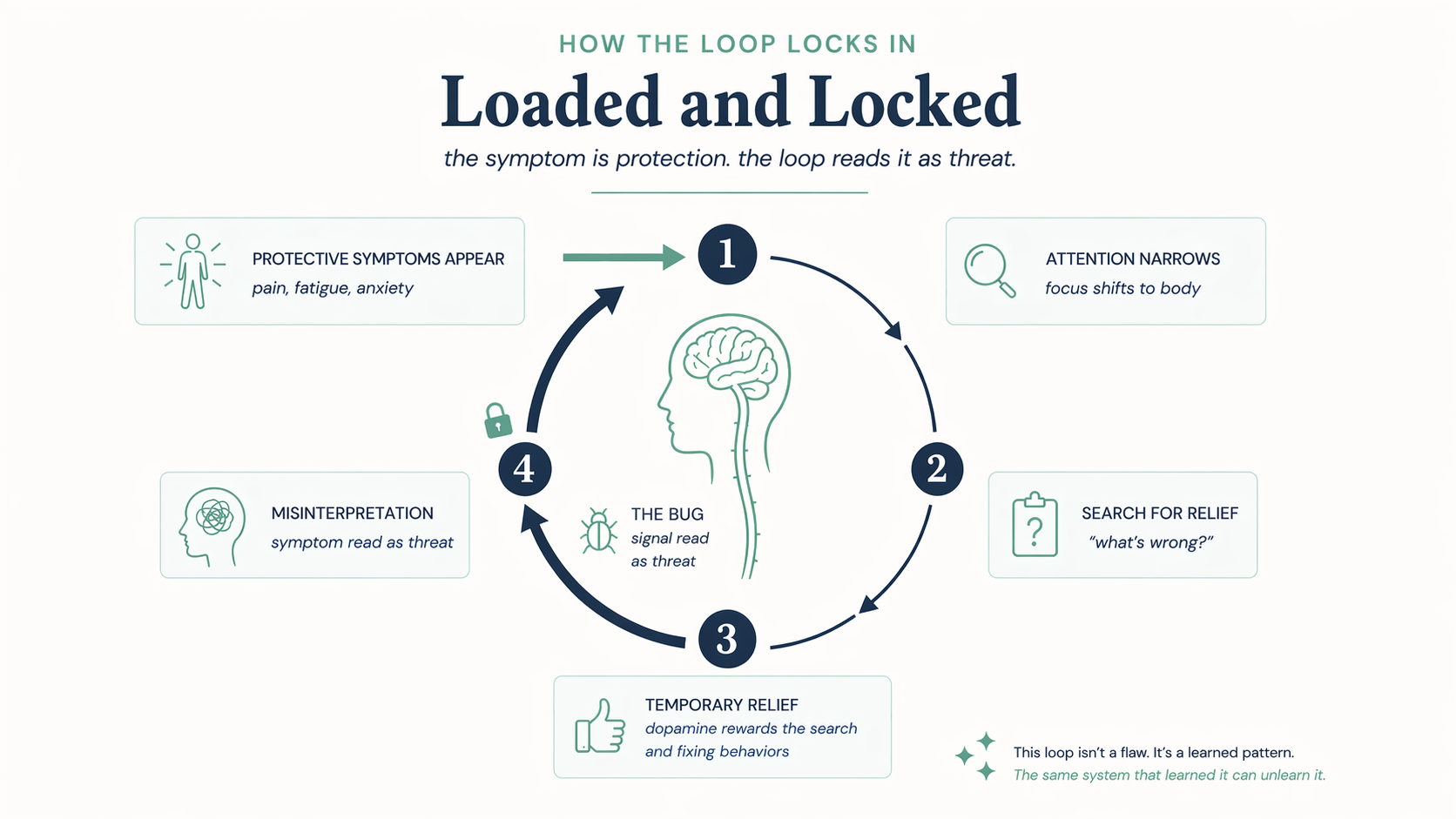
Health anxiety is what that loop feels like from the inside, hour by hour. Not a dramatic crisis. A quiet, constant negotiation with your own body.
Why "just stop thinking about it" fails
Being told to distract yourself does not work, and there is research suggesting the more mechanical versions of that advice do not work either.
Attention bias modification is a computerized training approach that tries to nudge attention away from threat-related cues. It is a reasonable idea on paper. A 2020 randomized controlled trial published in PAIN tested an established online protocol in 117 women with fibromyalgia and found no substantive improvement in pain or pain-related measures compared with a control condition, and no significant change in pain-related fear or anxiety sensitivity for either group. The wider literature on this approach in chronic pain is mixed at best.
That finding is worth taking seriously rather than skipping past, because it points at what the actual lever is. Simply redirecting where attention lands does not appear to do much. What changes the system is what the sensation means to it. A twinge that means possible damage keeps the alarm on. The same twinge, understood as a signal from a sensitized system rather than evidence of injury, does not.
What does help
Health anxiety itself responds well to structured psychological work. A 2017 systematic review and meta-analysis in Behavioural and Cognitive Psychotherapy pooled 14 trials and found a large effect for cognitive behavioural therapy compared with control conditions, sustained at six and twelve month follow-up. Those trials were in health anxiety generally, not in fibromyalgia specifically, so treat it as strong evidence that the pattern is workable rather than as a fibromyalgia result.
Three moves matter, and they work together rather than in isolation.
- Lower the baseline load. Sleep, movement, daylight, and fewer chronic stressors reduce how threat-primed the system is before any single sensation shows up. A calmer baseline makes everything else possible.
- Reduce checking gradually, not heroically. Going cold turkey on body scanning usually backfires. Shrinking it on purpose, a little at a time, gives the system evidence that not checking is survivable.
- Change what the sensation means. This is the core of nervous system retraining. You learn to meet a sensation with curiosity instead of alarm, which slowly teaches the alarm system that it does not need to fire.
A place to start this week
Pick one checking behavior. Just one, the one you do most. Then put a delay on it rather than a ban.
When the urge arrives, wait ten minutes before acting on it. Do something with your hands in the meantime. If the urge is still there after ten minutes, go ahead and check, without any self-criticism about it. The point is not to win. The point is to put a small gap between the sensation and the response, so the automatic pairing loosens. Many people notice that a share of urges simply dissolve in the gap. That is your nervous system showing you, in real time, that the sensation was never the emergency it felt like.
Not another protocol. A map.
The free Fibromyalgia Healing Roadmap lays out the four phases for calming a sensitized nervous system, including the de-monitoring work.
Get the free roadmapCommon questions
Is health anxiety causing my fibromyalgia?
Health anxiety is better understood as a driver that keeps symptoms loud than as the single cause of fibromyalgia. Anxiety raises the nervous system's threat level, and a threat-primed system amplifies ordinary body signals into pain. That makes anxiety both a consequence of living with chronic symptoms and an input that feeds them.
How common is anxiety in fibromyalgia?
Very common. A 2025 systematic review and meta-analysis in the Journal of Affective Disorders, pooling 92 studies and around 30,000 participants, found a prevalence of roughly 46.6 percent for comorbid anxiety and 50.8 percent for depression among people with fibromyalgia.
Why does checking my symptoms make me feel worse over time?
Checking produces brief relief, which teaches the brain that checking is a useful response and makes the urge return faster. It also signals to a sensitized nervous system that the sensation is worth investigating, which keeps the threat level and the pain signal elevated.
Do attention training apps help with fibromyalgia pain?
The evidence is not encouraging. A 2020 randomized controlled trial in PAIN tested an established attention bias modification protocol in 117 women with fibromyalgia and found no substantive improvement in pain or pain-related measures versus control. Changing what a sensation means to the nervous system appears to matter more than redirecting where attention points.
Can I work on health anxiety without ignoring real symptoms?
Yes, and that distinction matters. The goal is not to dismiss your body or skip medical care. It is to stop the constant monitoring that keeps the alarm system running. Keep your medical team involved, get new or changing symptoms properly assessed, and work on the monitoring habit separately.
References
Jafari M, et al. The global prevalence of depression and anxiety among fibromyalgia patients: A systematic review and meta-analysis. Journal of Affective Disorders. 2025. sciencedirect.com
Carleton RN, Duranceau S, Shulman EP, et al. Evaluating the efficacy of an attention modification program for patients with fibromyalgia: a randomized controlled trial. PAIN. 2020;161(3):584-594. pubmed.ncbi.nlm.nih.gov
Cooper K, Gregory JD, Walker I, Lambe S, Salkovskis PM. Cognitive Behaviour Therapy for Health Anxiety: A Systematic Review and Meta-Analysis. Behavioural and Cognitive Psychotherapy. 2017;45(2):110-123. pubmed.ncbi.nlm.nih.gov
Clauw DJ. Fibromyalgia: A Clinical Review. JAMA. 2014;311(15):1547-1555. jamanetwork.com
This article is for educational purposes only. It does not constitute medical advice, diagnosis, or treatment. Westlake Wellness coaching works alongside, not instead of, medical care. Always consult a qualified healthcare provider before making changes to your treatment plan.