Pain Acceptance Is Not Giving Up
Aug 20, 2026
The Loaded and Locked Model
Someone told you to accept the pain. Maybe a doctor, maybe a book, maybe a well meaning friend. It landed like being told to stop trying. For most people with fibromyalgia, pain acceptance sounds like a polite way of saying nothing more can be done. That is not what the word means in the research, and the difference matters more than almost any other distinction in chronic pain.
Short answer: In pain research, acceptance does not mean deciding your pain is permanent or that you stop working toward change. It means ending the moment to moment struggle against the sensation so your attention and energy return to your life. In fibromyalgia trials, increases in pain acceptance are one of the measured routes to lower symptom impact.
What pain acceptance actually means
In the acceptance and commitment therapy literature, acceptance of pain has a narrow technical meaning. It is the willingness to have the sensation present without fighting it, while continuing to move toward the things you care about. The opposite of acceptance is not hope. The opposite is struggle.
Read that definition again and notice what is missing. Nothing in it says the pain will last forever. Nothing in it says treatment is over. Nothing in it says the sensation is acceptable, deserved, or fine. It is a statement about what you do in the next hour, not a prediction about the next decade.
Resignation says: this will never change, so I will stop living. Acceptance says: this is here right now, and I am going to stop wrestling it and go live anyway. Those two states look similar from the outside on a hard day. Inside the nervous system they are close to opposites.
Why the word lands so badly
The reason acceptance sounds like surrender is usually not the word. It is who said it and when.
Most people with fibromyalgia hear it late, after years of tests that came back clean and appointments that ended without an explanation. In that context, learn to accept it is heard as we have run out of ideas. It arrives as a closing statement rather than a technique. That reading is reasonable, and it is why the concept gets rejected before it is ever understood. It is the same dynamic behind why reassurance never lasts: the words are technically true and they still fail, because they answer a question you were not asking.
What the trials actually found
Acceptance is not a slogan in this literature. It is a measured variable, and it has been tested.
A randomized controlled trial published in The Journal of Pain in 2018 assigned 67 people with fibromyalgia to either an online acceptance and commitment therapy program alongside usual care, or usual care alone. The treatment group improved significantly on fibromyalgia impact, with large differences between conditions at both post treatment and three month follow up. The finding that matters most here is the mediation result: increases in pain acceptance significantly accounted for those improvements. Depression, pain, and fear of movement also improved in favor of the treatment group.
A 2024 systematic review and meta analysis in the British Journal of Pain pooled the randomized trials of acceptance and commitment therapy in fibromyalgia. It found the approach superior to control conditions for health related quality of life and pain acceptance, both immediately after treatment and at follow up, with improvements also seen in anxiety, depression, pain, disability, and fatigue. Attrition was generally low and no adverse events were reported.
Two honest caveats. These are modest sized trials, and the 2018 study describes itself as preliminary. And a mediation finding is a statistical relationship, not proof of a mechanism. What the evidence supports is narrower than a cure claim and more useful than a platitude: when acceptance goes up, symptom impact tends to come down.
Acceptance is not a verdict on your future. It is a decision about what you do with this hour.
Why struggle is an input, not a neutral act
The Loaded and Locked model explains fibromyalgia symptoms through threat load, attention, and learned loops rather than tissue damage. Once you see it that way, the struggle against a sensation stops being a neutral reaction and becomes an input in its own right.
Fighting a sensation requires monitoring it. Monitoring keeps attention on the body. Sustained attention on a body signal, in a system already primed for danger, is one of the cues that tells the brain the signal is important and worth amplifying. That is the practical meaning of central sensitization: the gain on the signal is set by how dangerous the system judges it to be, and effortful resistance is read as evidence of danger.
So the struggle does something worse than fail. It feeds the loop it is trying to end.
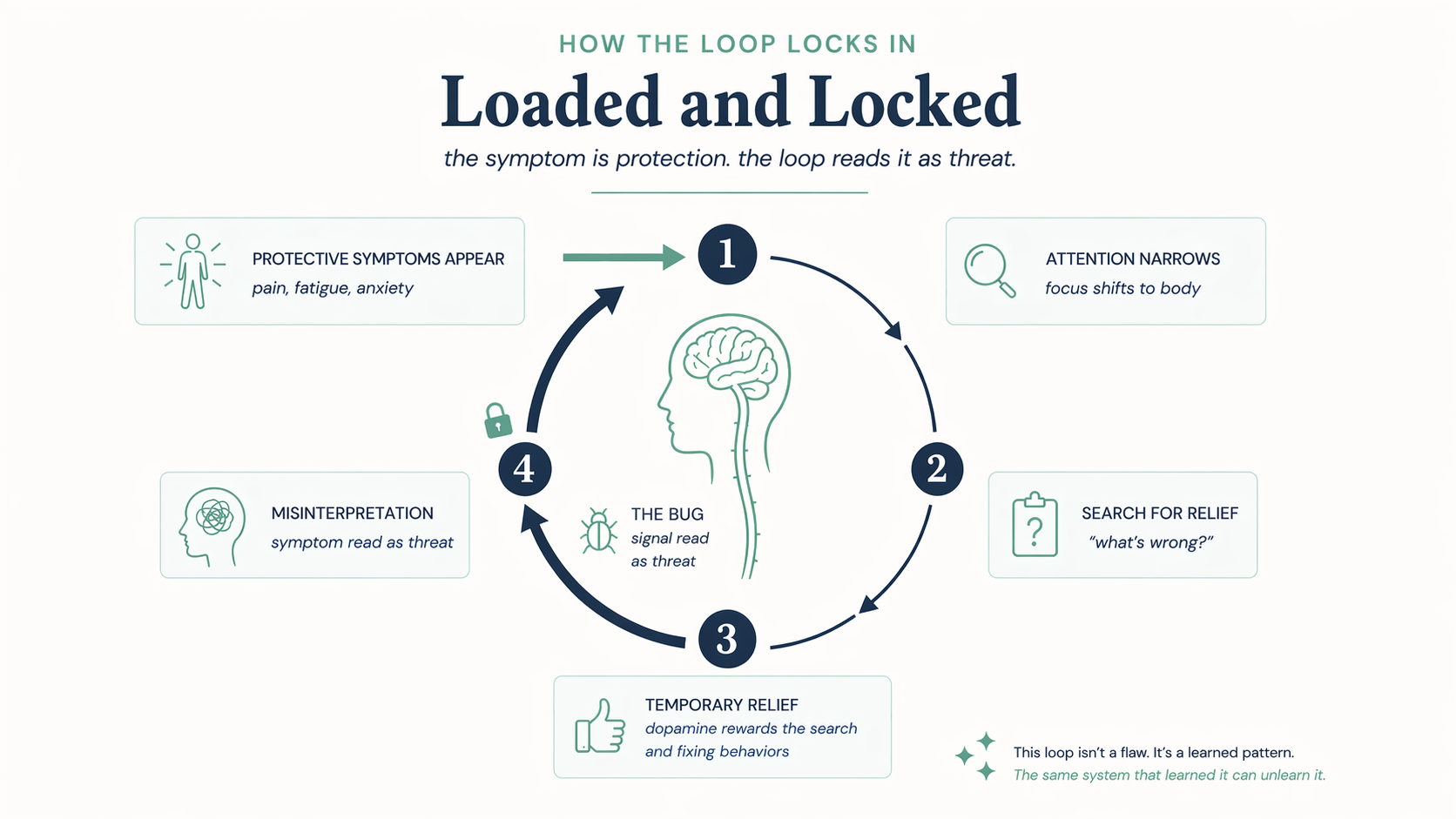
This is also why acceptance is not passive. Dropping the fight frees the attention and energy that the fight was consuming. That freed capacity is what goes back into movement, work, and people, which is the same direction of travel described in the Loaded and Locked model.
What acceptance is not
- It is not believing the pain is permanent. Acceptance is about the present sensation, not the long term outlook.
- It is not stopping medical care. Keep your appointments, keep investigating anything undiagnosed, keep your medication decisions with your prescriber.
- It is not liking it. Willingness and approval are different things.
- It is not agreeing that it is all in your head. The pain is real and physically generated. Acceptance says nothing about whether it is real.
- It is not positive thinking. You are not talking yourself into feeling better. You are stopping a specific fight.
What it looks like on a hard day
Acceptance is not a mood you summon. It is a set of small moves, repeated.
- Name the sensation plainly. Aching in the shoulders, heaviness in the legs. Plain description keeps the sensation a sensation rather than a verdict.
- Drop the fix-it search mid-flare. The urge to find the cause right now is the loop asking to be fed. The question can wait until the flare passes.
- Choose one valued action anyway. Small and real. A short walk, a phone call, twenty minutes of work. The action is the point, not the size.
- Stop grading the day. Scoring a day out of ten reinstalls the monitoring you are trying to reduce.
- Notice the second arrow. There is the sensation, and there is what you add about what it means. The second one is workable today.
Acceptance is often harder for people carrying a trauma history, because a system that learned the world is unsafe does not drop its guard on request. That is worth naming rather than pushing through, and it is covered in more detail in what the research on fibromyalgia and trauma actually shows. Processing trauma is therapist work, not coaching work.
Where acceptance sits on the map
Acceptance is not the whole of recovery and it is not the first step. It sits alongside lowering baseline load, improving sleep and movement, and learning to be with sensation without reacting to it. On its own it is a stance. Combined with the rest, it is the thing that stops the daily fight from quietly undoing the other work.
If you want the sequence rather than the concept, the free roadmap below lays out the phases in order. If you would rather work it with a coach, you can apply for the program.
Common questions
Does accepting pain mean I have to give up on getting better?
No. In the research, acceptance refers to ending the moment to moment struggle with a sensation that is already present, not to a belief that the pain is permanent. It says nothing about your long term outlook and does not require you to stop treatment or stop working toward change.
Is there evidence that pain acceptance helps fibromyalgia?
Yes, though the trials are modest in size. A 2018 randomized controlled trial in The Journal of Pain found that improvements in fibromyalgia impact from an online acceptance based program were significantly mediated by increases in pain acceptance. A 2024 systematic review and meta analysis found acceptance and commitment therapy superior to control for quality of life and pain acceptance in fibromyalgia.
What is the difference between acceptance and resignation?
Resignation concludes that nothing will change and withdraws from life as a result. Acceptance drops the struggle with the current sensation and keeps moving toward what matters anyway. They can look alike from outside, but resignation reduces activity while acceptance protects it.
Why does fighting the pain make it worse?
Fighting a sensation requires monitoring it, and sustained attention on a body signal in a threat primed nervous system is one of the cues that tells the brain the signal matters and should be amplified. Effortful resistance is read as evidence of danger, so the struggle feeds the loop it is trying to end.
How do I practice acceptance during a flare?
Describe the sensation in plain physical terms, postpone the urge to find a cause until the flare passes, choose one small valued action anyway, and stop scoring the day out of ten. These are small repeated moves rather than a mood you have to summon.
Not another protocol. A map.
The free Fibromyalgia Healing Roadmap lays out the four phases for calming a sensitized nervous system, in order.
Get the free roadmapReferences
Simister HD, Tkachuk GA, Shay BL, Vincent N, Pear JJ, Skrabek RQ. Randomized Controlled Trial of Online Acceptance and Commitment Therapy for Fibromyalgia. The Journal of Pain. 2018;19(7):741-753. pubmed.ncbi.nlm.nih.gov
Eastwood F, Godfrey E. The efficacy, acceptability and safety of acceptance and commitment therapy for fibromyalgia, a systematic review and meta-analysis. British Journal of Pain. 2024. pubmed.ncbi.nlm.nih.gov
Clauw DJ. Fibromyalgia: A Clinical Review. JAMA. 2014;311(15):1547-1555. jamanetwork.com
This article is for educational purposes only. It does not constitute medical advice, diagnosis, or treatment. Westlake Wellness coaching works alongside, not instead of, medical care. Always consult a qualified healthcare provider before making changes to your treatment plan.