Why Reassurance Never Lasts With Fibromyalgia
Aug 03, 2026
The Loaded and Locked Model
The appointment goes well. The rheumatologist looks at the scan, looks at the bloodwork, and tells you there is no damage. Nothing is wrong structurally. You feel the tightness in your chest let go a little on the drive home. By nine that evening the ache in your shoulder is back and so is the question, and you are already composing the message you will send to the forum. If reassurance never lasts with fibromyalgia, that is not a personal failing. It is the predictable behavior of a nervous system that has learned something specific.
Short answer: Reassurance lowers threat for a short window, then wears off, because the relief itself is what teaches the brain to seek reassurance again. Each round of checking, asking, or re-reading confirms to a sensitized system that the sensation was worth investigating. The relief gets shorter and the need gets faster. What changes the pattern is not better reassurance. It is lowering the system's overall threat load and changing what the sensation means.
What reassurance actually does in the moment
Reassurance works. That is the whole problem.
You feel something in your body. Threat rises. You get information, from a doctor, a partner, a search result, a Facebook group. Threat drops. Your brain is a learning machine running on very short timescales, and what it just recorded is simple: that behavior produced relief.
Nothing about this is irrational. A system that finds a reliable way to reduce distress will reach for it again, sooner, and with more force. That is competent learning, not a character flaw. It only looks like a problem when you zoom out and notice that the interval between rounds keeps shrinking.
Why the relief has a half life
Reassurance answers a question. It does not change the state that generates the question.
Fibromyalgia involves central sensitization, an amplified processing of pain and threat signals in the brain and spinal cord. A sensitized system runs a continuous background estimate of how dangerous things are. Being told the scan is clean is one data point arriving into a system that is already generating alarm on its own. The data point gets absorbed. The generator keeps running.
So the relief decays on a schedule. An hour, an afternoon, a day if the appointment went well. Then the next sensation arrives, and it arrives into the same threat estimate as before, because nothing about the estimate was updated. Only the question was answered.
The research does not say this is just you
This pattern has been studied directly in pain care, and the findings are less comfortable than most patient-facing writing admits.
In 2008 Linton, McCracken and Vlaeyen published a topical review in the journal PAIN asking whether reassurance helps or hinders in the treatment of pain. Their conclusion was that reassurance is not straightforwardly beneficial, that its effects depend heavily on how it is delivered, and that in some circumstances it can maintain the very problem it is meant to settle.
A 2021 qualitative review in Behavioral Sciences by Cheung and Soundy synthesized 24 studies covering 451 patients with musculoskeletal pain. It found that reassurance produces both positive and negative outcomes depending on mechanism. What helped was relationship, individualized attention, education, and concrete self management strategies. What backfired was reassurance delivered through a purely structural, pathoanatomic frame, which patients frequently misinterpreted in ways that increased fear.
A 2025 study in the journal Health analyzed 19 recorded hospital consultations with chronic musculoskeletal pain patients, plus interviews with both patients and clinicians afterward. It identified four dominant forms of explicit reassurance in use, including validation through scan findings and normalizing the pain. The authors described a lack of congruence between what patients actually experience and the biomedical knowledge clinicians rely on to reassure them.
A normal scan answers a question your body never asked. Your body asked whether it is safe.
The loop, drawn
This is the pattern we call locked. Symptom triggers search. Search produces brief relief. Relief reinforces the search. Over time the brain, having learned that symptom plus search is a useful pair, has a reason to keep the symptom loud enough to trigger the search. It is laid out in full in the fibromyalgia pain-search loop.
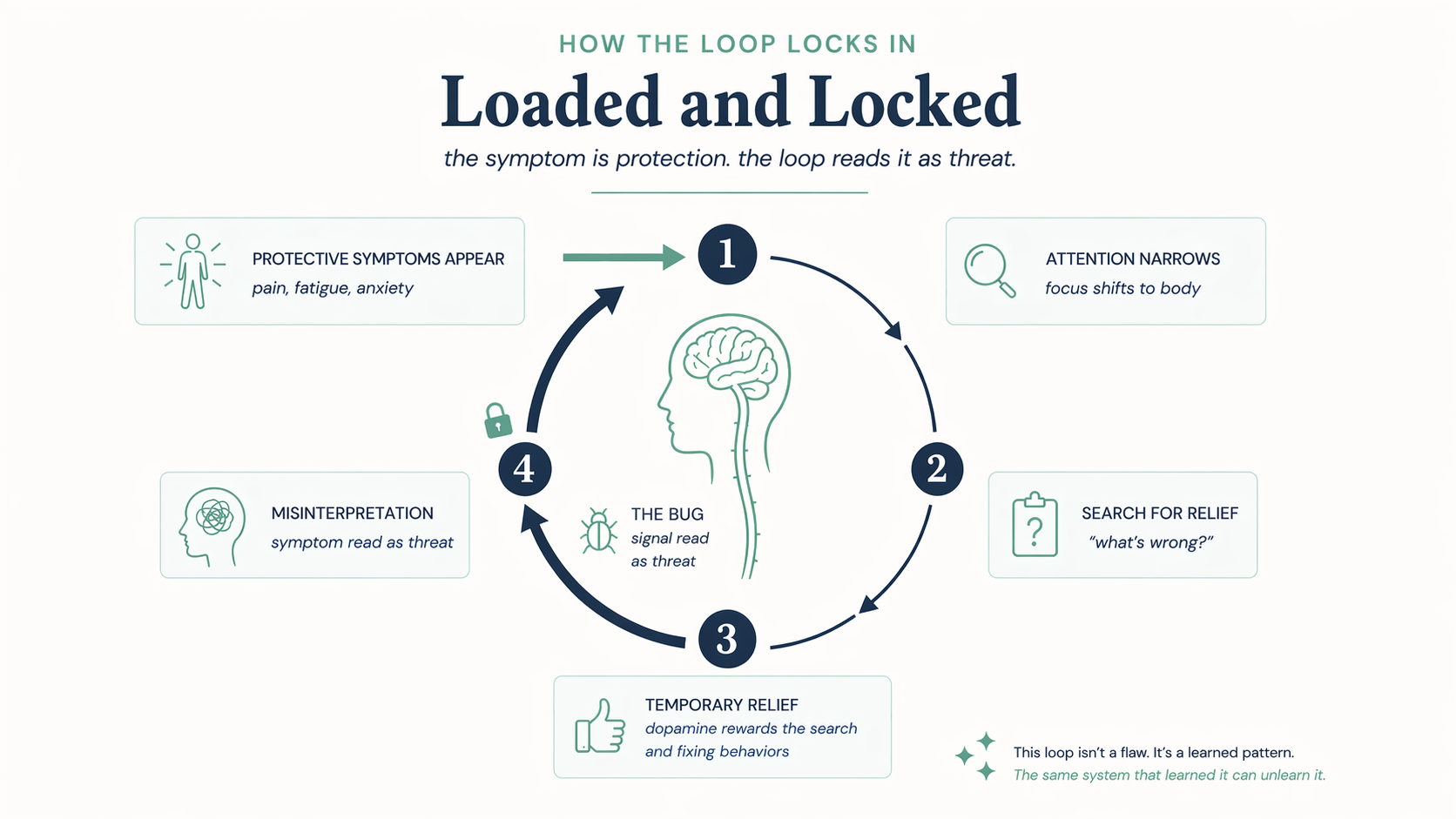
Reassurance seeking is this loop in its most social form. Instead of pressing the sore spot or opening a search tab, you ask a person. The mechanics are identical. The relief is a little warmer and lasts a little longer, which makes it harder to see.
Why "your scans are normal" often lands as dismissal
There is a second thing happening, and it deserves saying plainly.
When the only reassurance on offer is structural, the implied message is that if nothing is broken, there is nothing to explain. Most people with fibromyalgia have heard some version of this for years. It does not feel like comfort. It feels like the end of the conversation.
The nervous system model is not a softer way of saying the pain is imaginary. It is the opposite. It says the pain is real, it is being produced by a system doing exactly what a protective system does, and that system can be worked with. That distinction is covered in is fibromyalgia pain real, or is it in your head.
What settles a system instead of reassuring it
Three moves, and they work together rather than in sequence.
- Lower the baseline load. Sleep, daylight, movement, and fewer chronic stressors change how threat primed the system is before any single sensation arrives. This is the unglamorous work and it makes everything else possible.
- Reduce the seeking gradually rather than banning it. Going cold turkey on asking, checking, and searching usually rebounds. Shrinking it deliberately gives the system repeated evidence that not knowing right now is survivable.
- Change what the sensation means. A twinge that means possible damage keeps the alarm on. The same twinge, understood as output from a sensitized system, does not. This is the core of nervous system retraining.
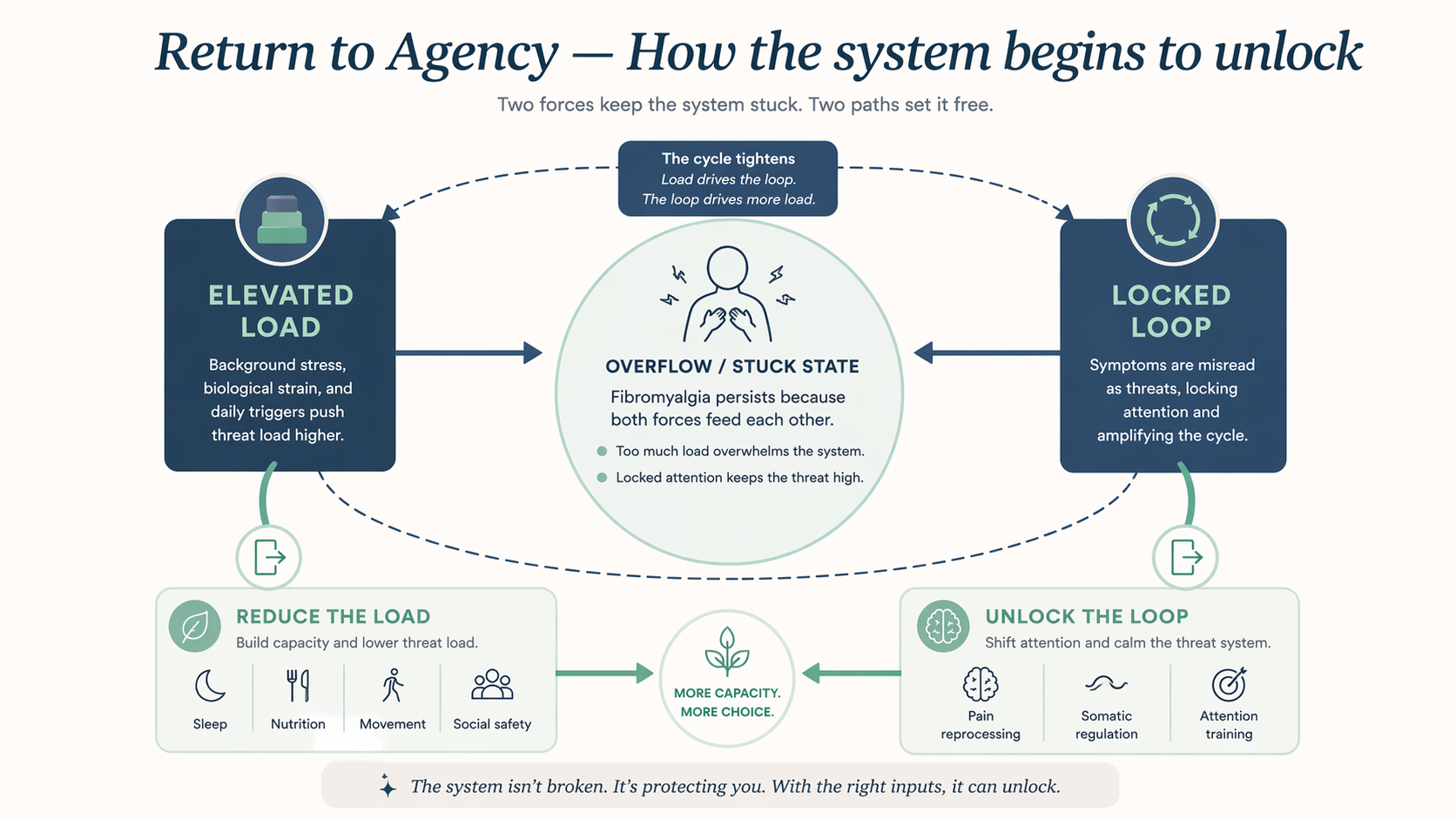
Notice what is missing from that list. Nowhere does it say get a better answer. The answers were never the mechanism.
A place to start this week
Pick the single reassurance behavior you reach for most. Asking your partner whether this looks normal. Re-reading the same lab result. Posting in the group.
Do not ban it. Put a delay on it. When the urge arrives, wait twenty minutes, and put your hands on something else in the meantime. If it is still there after twenty minutes, go ahead, without any self criticism about it.
What you are building is not willpower. It is a gap between the sensation and the response, so the automatic pairing loosens. Most people find that a real share of urges simply dissolve inside the gap. That is your nervous system showing you, without argument, that it was never the emergency it felt like. This is also the pattern underneath fibromyalgia and health anxiety, if you want the wider picture.

Not another protocol. A map.
The free Fibromyalgia Healing Roadmap lays out the four phases for calming a sensitized nervous system, including the de-monitoring work. If you would rather do it with structure and a coach, you can apply for the program.
Get the free roadmapCommon questions
Why does reassurance stop working over time with fibromyalgia?
Because the relief is the reinforcer. Reassurance briefly lowers threat, which teaches the brain that seeking reassurance is an effective response, so the urge returns faster and more often. The underlying threat state that generates the worry is never updated, only the individual question is answered.
Does asking my doctor for reassurance make my symptoms worse?
Not in a simple cause and effect way, and this is not a reason to skip medical care. What research on pain consultations suggests is that reassurance delivered purely as a structural all clear often fails to reduce fear and can be misread in ways that increase it. Repeated seeking also keeps attention pointed at the body, which keeps a sensitized system alert.
Is reassurance seeking the same as health anxiety?
They overlap heavily. Reassurance seeking is one of the main behaviors within health anxiety, alongside checking, body scanning, and repeated searching. In the Loaded and Locked model all of these are versions of the same pain-search loop, expressed through different channels.
How do I stop asking for reassurance without ignoring my body?
The goal is not to dismiss symptoms or avoid medical care. Keep your medical team involved and get new or changing symptoms properly assessed. The work is on the repetitive seeking that follows an answer you already have. A delay of ten to twenty minutes before acting on the urge is a common place to start.
What kind of reassurance actually helps?
A 2021 qualitative review of 24 studies found that helpful reassurance in musculoskeletal pain involved relationship building, an individualized approach, education, and concrete self management strategies. Reassurance framed purely around structure and imaging findings was the version most likely to be misinterpreted and to raise fear.
References
Linton SJ, McCracken LM, Vlaeyen JWS. Reassurance: help or hinder in the treatment of pain. PAIN. 2008;134(1):5-8. pubmed.ncbi.nlm.nih.gov
Cheung L, Soundy A. The Impact of Reassurance on Musculoskeletal (MSK) Pain: A Qualitative Review. Behavioral Sciences. 2021;11(11):150. mdpi.com
Andersen TCB, Wilhelmsen M, Lian OS. The MRI-scan says it is completely normal: Reassurance attempts in clinical encounters among patients with chronic musculoskeletal pain. Health. 2025. pmc.ncbi.nlm.nih.gov
Clauw DJ. Fibromyalgia: A Clinical Review. JAMA. 2014;311(15):1547-1555. jamanetwork.com
This article is for educational purposes only. It does not constitute medical advice, diagnosis, or treatment. Westlake Wellness coaching works alongside, not instead of, medical care. Always consult a qualified healthcare provider before making changes to your treatment plan.