Fear of Movement in Fibromyalgia: What Kinesiophobia Really Is
Aug 24, 2026
Symptoms and Flares
You used to walk. Then one week you walked further than usual and paid for it for four days. So you walked less. Then a class left you flattened, so you stopped the class. Now the thought of a long day on your feet produces a small drop in your stomach before you have moved at all. Fear of movement in fibromyalgia is common, it has a clinical name, and it is not a character flaw.
Short answer: Kinesiophobia is the fear of moving because movement is expected to cause pain or damage. In fibromyalgia it is usually learned rather than irrational, because flares really did follow activity. The problem is that avoiding movement teaches the nervous system that movement is dangerous, which makes the next attempt harder.
What kinesiophobia actually is
Kinesiophobia is defined as an excessive and debilitating fear of movement and physical activity, driven by a sense of vulnerability to pain or injury. It is measured in research with a questionnaire, most often the Tampa Scale of Kinesiophobia.
The word contains a trap. Clinical definitions usually call the fear irrational, and that word does real damage when a patient reads it. There is nothing irrational about expecting pain from movement when movement has produced pain many times. The prediction is accurate about the past. It is just no longer useful for the future.
That distinction matters more than the label. This is not a fear you invented. It is a fear your system learned, from evidence, on the job.
Why the fear is earned
Symptom flares after physical activity are a defining feature of fibromyalgia. That is not a misperception. Do more than usual, and there is a real cost that lands hours or days later.
So the system does exactly what a well functioning threat detector should do. It links the activity to the cost, then starts flagging the activity in advance. The next time you consider a long walk, the flag fires before your shoes are on. In the Loaded and Locked model this is anticipatory signaling, the same mechanism described in why your brain predicts pain before it happens. The brain is not reporting on your body. It is forecasting.
How avoidance turns a flare into a pattern
The fear avoidance model has been studied in chronic musculoskeletal pain for over twenty years, and its structure is simple. Pain leads to fear. Fear leads to avoidance. Avoidance produces two effects: physical deconditioning, and, more importantly, no new evidence.
That second effect is the one that locks the pattern in. Every time you skip the walk, you do not find out whether that walk would have been fine. The prediction goes untested, so it stands. Avoidance feels like protection and functions as confirmation.
Meanwhile the world narrows. First the long walks go, then the stairs, then the standing, then the plans. Each removal is individually sensible and the sum of them is a smaller life. The same shape appears in the fibromyalgia pain search loop, where a behavior that delivers short term relief quietly teaches the system that the threat was real.
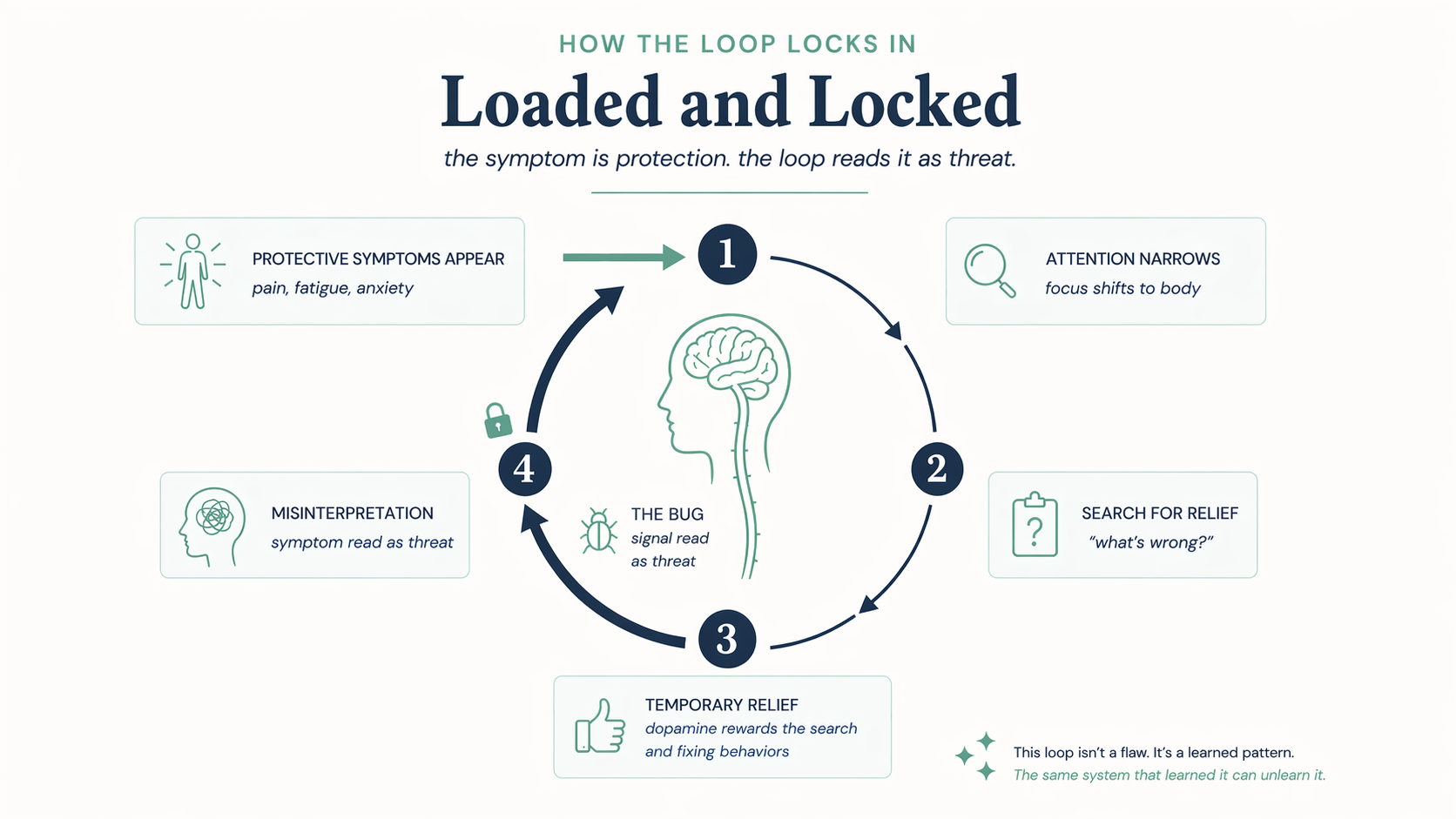
Avoidance feels like protection. It functions as confirmation.
The two failure modes, not one
Research on fear of movement in fibromyalgia and chronic fatigue describes two different patterns, and treating them the same way is why generic exercise advice so often fails.
- The avoider cuts activity down to whatever is guaranteed safe. Function shrinks steadily. Flares get rarer and the fear gets larger.
- The persister pushes through, ignores early signals, has a good day, does far too much, and crashes. Then rests for days and repeats. This is the boom and bust cycle.
Both are fear driven. The avoider is managing fear by never testing it. The persister is managing fear by proving it wrong in one enormous burst, which produces the flare that proves it right. The clinical literature suggests that tailoring the approach to which pattern a person is in is more promising than a single standard exercise prescription.
What the exercise evidence honestly says
A Cochrane review of aerobic exercise training for adults with fibromyalgia, covering 13 studies and 839 people, found that moderate intensity aerobic exercise may improve quality of life, pain, stiffness and physical function. The evidence was rated low to moderate certainty because of small study sizes.
The review also says two things that most exercise advice leaves out. Exercise did not appear to improve fatigue. And while the programs were safe for most participants, some people did experience increased pain, soreness or tiredness during or after exercise. The recommendation is to raise intensity slowly, and to cut back when symptoms rise rather than push on.
That is the honest version. Movement helps, movement can also cost, and the answer is dosage rather than willpower.
What to do instead of pushing or stopping
The goal is not to prove you are tough. It is to give your nervous system new evidence, in doses small enough that it can be believed.
- Pick an amount you are confident about. Not the amount you used to do. The amount you are almost certain is safe, even on an average day. Ten minutes is a real starting point.
- Hold it steady before you increase it. The value is in repetition, not progression. A repeated safe experience is the evidence. A single big day is not.
- Keep the dose fixed on good days. The good day is when the persister pattern does its damage. Doing the planned amount on a good day is the harder skill and the more useful one.
- Separate discomfort from damage. Aching muscles after movement are not injury. That distinction is the practical meaning of central sensitization, where signal volume is set by perceived threat rather than tissue state.
- Do not grade every session. Scoring each attempt reinstalls the monitoring you are trying to reduce. Show up, do the dose, move on.
- Expect the fear to lag. The feeling of dread usually fades after the evidence, not before it. Waiting to feel ready is waiting for the wrong signal.
None of this means overriding a flare in progress. When symptoms are high, the job is settling the system, which is covered in how to calm a fibromyalgia flare. Fear of movement work happens between flares, not during them.
Where this sits on the map
Fear of movement is not a separate problem from fibromyalgia. It is one of the clearest places you can watch the loop operate, which also makes it one of the clearest places to interrupt it. Dropping the fight with the sensation, described in pain acceptance is not giving up, is what makes a steady dose possible in the first place.
The order matters. Lower the baseline load first, then rebuild movement in doses small enough to be believed. The free roadmap below lays out those phases in sequence.
Common questions
What is kinesiophobia in fibromyalgia?
Kinesiophobia is a fear of movement and physical activity driven by an expectation that moving will cause pain or harm. In fibromyalgia it is usually learned from real experience, because symptom flares genuinely do follow activity, which makes the prediction accurate about the past even when it is no longer useful going forward.
Is being afraid to exercise with fibromyalgia irrational?
No. Research definitions often use the word irrational, but the fear typically forms because activity really was followed by flares. The system is doing what a threat detector should do. What keeps it stuck is that avoidance prevents any new evidence from arriving, so the prediction is never updated.
Does exercise actually help fibromyalgia?
A Cochrane review of 13 studies and 839 adults found that moderate intensity aerobic exercise may improve quality of life, pain, stiffness and physical function, with low to moderate certainty evidence. It did not appear to improve fatigue, and some participants experienced increased symptoms. The guidance is to increase intensity slowly and cut back if symptoms rise.
What is the boom and bust cycle?
Boom and bust is the pattern of doing far too much on a good day, crashing for several days afterwards, then repeating. It is fear driven in the same way avoidance is. The person is trying to prove the fear wrong in one large burst, and the resulting flare ends up confirming it instead.
How do I start moving again without triggering a flare?
Start with an amount you are confident is safe even on an average day, hold that amount steady for a stretch rather than increasing it, and keep the dose the same on good days. Repeated safe experiences are what update the prediction. A single large day does not. This work belongs between flares, not during one.
Not another protocol. A map.
The free Fibromyalgia Healing Roadmap lays out the four phases for calming a sensitized nervous system, in order.
Get the free roadmapReferences
Nijs J, Roussel N, Van Oosterwijck J, et al. Fear of movement and avoidance behaviour toward physical activity in chronic-fatigue syndrome and fibromyalgia: state of the art and implications for clinical practice. Clinical Rheumatology. 2013;32(8):1121-1129. link.springer.com
Vlaeyen JWS, Linton SJ. Fear-avoidance model of chronic musculoskeletal pain: 12 years on. Pain. 2012;153(6):1144-1147. pubmed.ncbi.nlm.nih.gov
Bidonde J, Busch AJ, Schachter CL, et al. Aerobic exercise training for adults with fibromyalgia. Cochrane Database of Systematic Reviews. 2017;6:CD012700. cochranelibrary.com
Clauw DJ. Fibromyalgia: A Clinical Review. JAMA. 2014;311(15):1547-1555. jamanetwork.com
This article is for educational purposes only. It does not constitute medical advice, diagnosis, or treatment. Westlake Wellness coaching works alongside, not instead of, medical care. Always consult a qualified healthcare provider before starting or changing an exercise program.