Pain Catastrophizing in Fibromyalgia Is Not a Character Flaw
Nov 02, 2026
Loaded and Locked
Someone told you that you catastrophize. Maybe a doctor. Maybe a physical therapist. You heard one message: you are making this worse than it is.
Short answer: Pain catastrophizing is a measurable pattern of rumination, magnification, and helplessness about pain. In fibromyalgia it links modestly to wider pain and lower function. Brain imaging suggests it reflects how the brain weighs threat, not weak character. It is a pattern you can work with, not a verdict.
Pain catastrophizing in fibromyalgia has a reputation problem. The word sounds like an accusation. The research behind it is more careful, and more useful, than the way it gets used in the exam room.
What pain catastrophizing actually means
Researchers measure it with a questionnaire. The questionnaire asks about three things.
- Rumination. "I can't stop thinking about how much it hurts."
- Magnification. "I worry that something serious will happen."
- Helplessness. "There is nothing I can do to make it better."
The result is a score. It describes how a mind behaves when it is under threat and in pain. Anyone who has hurt for years will recognize some of those items. That is the point. The scale measures a common human response, not a defect.
Why the word lands as an insult
In clinic the word often arrives as a conclusion: you are making it worse. The hidden claim is that the pain lives in your thinking. That is not what the research says. Fibromyalgia pain is real. I covered that directly in Is Fibromyalgia Pain Real, or Is It in Your Head?
Consider the history. You hurt. Scans came back normal. You were told it was stress. Expecting the worst after that is not a flaw. It is a prediction built from evidence. Your brain learned that pain is unexplained and that help is unreliable. I explain how that prediction process works in Why Your Brain Predicts Pain Before It Happens.
What the brain imaging found
In 2021 a team led by Dan-Mikael Ellingsen published a study in the journal Pain. It included 79 people with fibromyalgia. Each person drew where they hurt on a digital body map. Each completed a catastrophizing questionnaire. Each had a resting brain scan.
Three findings stand out.
- Higher catastrophizing went with more widespread pain.
- More widespread pain went with stronger connectivity between the salience network and the posterior cingulate cortex.
- That connectivity statistically linked catastrophizing to pain widespreadness.
In plain terms: the salience network flags what matters right now. The posterior cingulate belongs to the default mode network, which runs self-focused thought. In people who hurt in more places, those two systems talked more. The authors proposed this cross-network connectivity as a possible mechanism.
What the study does not show
Read this part twice. The link between catastrophizing and widespread pain was modest (r = 0.26). Catastrophizing explains only a small share of the variation between people. The study scanned each person once. It cannot say whether thought patterns shape the brain pattern, whether the brain pattern shapes the thoughts, or whether both feed each other.
The honest reading is limited. Catastrophizing is one marker among many. It is not the cause of fibromyalgia. Any claim that goes further outruns the data.
A catastrophizing thought is a forecast, not a fact. It tells you what the alarm expects, not what is true today.
Why it still matters for daily life
A 2021 study in the Journal of Clinical Medicine looked at 107 people with fibromyalgia. Higher pain and higher catastrophizing, along with lower mindfulness, went with worse functioning. Catastrophizing sat between pain intensity and functioning as a significant indirect pathway. This was a cross-sectional design, so it shows association only. The authors concluded that catastrophizing is an especially important factor for reduced functioning and suggested that catastrophizing-reducing treatments such as cognitive behavioral therapy are likely to help.
A 2026 systematic review in Pain Management Nursing pulled together 20 randomized trials in chronic musculoskeletal pain. Thirteen reported a significant link between catastrophizing and pain outcomes such as intensity and disability. Most of those trials involved chronic back pain, not fibromyalgia. Treat it as supporting context, not proof for this condition.
The practical takeaway is the same across all three sources. The pattern tracks with how much pain disrupts life. That makes it worth working on.
Where catastrophizing sits in the Loaded and Locked model
In the Loaded and Locked model, the system is loaded with threat and the brain has learned to keep the alarm on. Catastrophizing is the verbal layer of that alarm. The brain predicts danger. Thoughts follow the prediction. The thoughts feed the next prediction. The loop locks in.
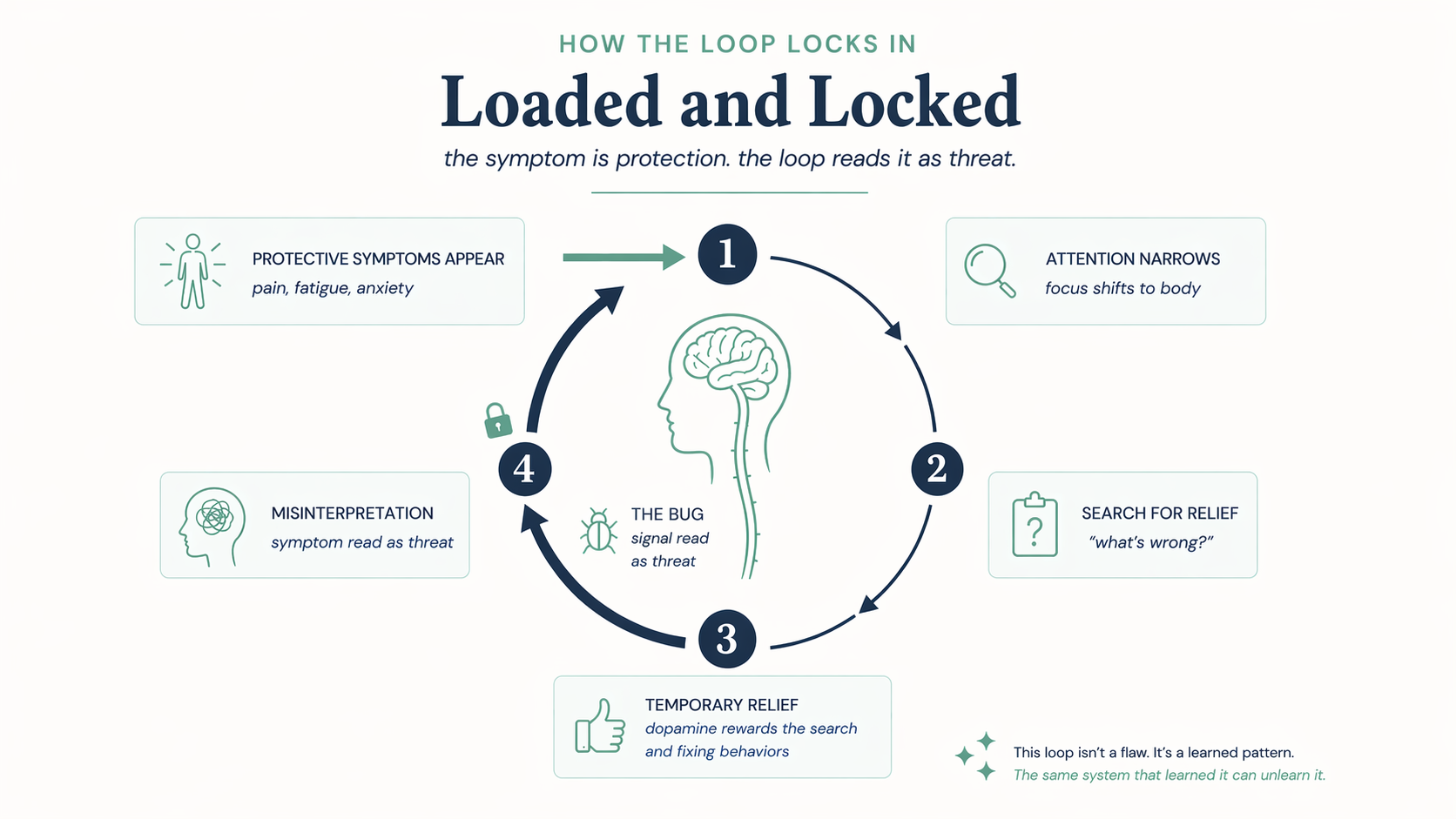
This is the same loop behind symptom searching and checking. See The Fibromyalgia Pain-Search Loop and How to Stop Body Scanning With Fibromyalgia. Catastrophizing is not the root. It is a visible part of the loop, which makes it a handle you can grab.
Fibromyalgia pain is real. It's also neuroplastic. That means it can be retrained.
What to do with a catastrophizing thought
These steps are practice, not treatment. They train awareness of the pattern. If catastrophizing is heavy or comes with low mood or panic, bring it to a licensed clinician.
- Name it as the alarm. Say it plainly: "That is the alarm forecasting." The thought is real. The forecast is not a fact.
- Check the evidence for today. Not the worst case. Today. What is actually happening in your body right now?
- Swap the time word. Change "never" and "always" to "right now" and "this week."
- Answer helplessness with one small action. Pick something within reach that is yours to do. The size matters less than the signal that you have a move.
- Practice when calm. The skill builds on easy days. It is hard to learn it for the first time mid-flare.
- Use the right help. Cognitive behavioral and acceptance-based therapies target this pattern. Read Pain Acceptance Is Not Giving Up for the acceptance side.
One caution. Do not use these steps to talk yourself out of a new or changing symptom. That belongs with your clinician.
Common questions
What is pain catastrophizing?
Pain catastrophizing is a pattern of thinking about pain that researchers measure with a questionnaire. It covers rumination (can't stop thinking about the pain), magnification (fear that something serious is coming), and helplessness (nothing I do will help). It is a score. It is not a judgment of your character.
Does catastrophizing mean my pain is not real?
No. The pain and the thought pattern are both real and they interact. Studies link higher catastrophizing to wider pain and lower function in fibromyalgia. None of that makes the pain imaginary.
Does catastrophizing cause fibromyalgia?
The research does not show that. The brain imaging study found a modest association between catastrophizing and how widespread pain was. An association at one point in time cannot say which came first or whether one causes the other.
Can pain catastrophizing be reduced?
Researchers treat it as a modifiable factor. The authors of a 2021 fibromyalgia study suggested that treatments aimed at catastrophizing, such as cognitive behavioral therapy, are likely to help functioning. A licensed clinician can guide that treatment. A coach can help you notice the pattern and practice a different response alongside it.
How do I tell catastrophizing from a real warning sign?
You do not have to decide alone. A new or changed symptom belongs with your clinician, even if you have fibromyalgia. A familiar pain paired with a frightening forecast is the pattern this article describes. Both can happen in the same week.

Not another protocol. A map.
The free Fibromyalgia Healing Roadmap lays out the four phases for calming a sensitized nervous system.
Get the free roadmapReferences
- Ellingsen DM, Beissner F, Alsady TM, et al. A picture is worth a thousand words: linking fibromyalgia pain widespreadness from digital pain drawings with pain catastrophizing and brain cross-network connectivity. Pain. 2021;162(5):1352-1363. PubMed
- Paschali M, et al. Modifiable psychological factors affecting functioning in fibromyalgia. J Clin Med. 2021. PubMed
- Shimada S, et al. A systematic review of pain catastrophizing and chronic musculoskeletal pain. Pain Manag Nurs. 2026. PubMed
This article is educational and is not medical advice. Westlake Wellness is a coaching practice. A coach does not diagnose, prescribe, or cure. This work sits alongside your medical care, not in place of it.